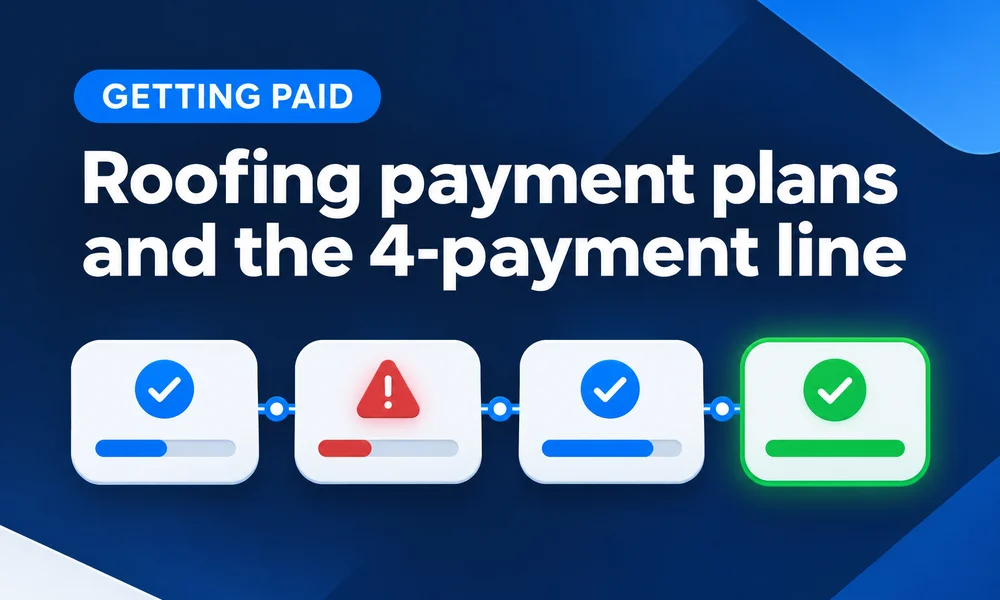
On an insurance roof job, a lien waiver follows the money one check at a time. For each payment you sign a waiver for that amount only, and you keep it conditional until the money has cleared your bank account. An unconditional waiver is for money you already have. A final waiver waits for the last check, which on most roof claims is the released depreciation, not the first carrier check. And you collect the same papers from your supplier and your subs before you hand yours to the homeowner or the mortgage company.
I build CRM For Claims, a CRM for roofing and restoration companies that work insurance claims. The lien waiver question nearly always arrives the same way: the loss draft desk of the homeowner's lender sends a packet, one of the forms says "waiver of lien", and somebody in the office signs it so the check can move. Most of the time that is fine. The time it is not fine, it costs the whole roof.
Four kinds of lien waiver, sorted by two questions
Every waiver answers two questions. Does it take effect when you sign, or only when the payment clears? And does it cover one payment, or the whole job? Two answers each make four forms, and on a roof claim each one has its moment.
The names change from state to state, and some states print the exact wording in their statute. The two questions do not change, so read the first paragraph of any form you are handed and answer them before you look for the signature line.
Which waiver goes with which check on one roof claim
The numbers below are made up to show the order. The approved roof is $21,000. The carrier holds back $3,600 in depreciation and subtracts the $2,000 deductible, so the first check is $15,400, made out to the homeowner, the lender and your company. The lender deposits it and pays it out in two draws, the second after its own inspection.
| Payment | Amount | Who asks for the waiver | Which waiver, and when |
|---|---|---|---|
| First draw from the lender, before the tear-off | $7,700 | The loss draft desk | Conditional progress for $7,700, sent with their packet. Not for $15,400: the waiver matches the draw, not the check. |
| Second draw, after the lender inspects the roof | $7,700 | The loss draft desk | Conditional progress for the second $7,700. If they also want the first draw made unconditional, do it now: that money has cleared. |
| Deductible, paid by the homeowner | $2,000 | Sometimes the homeowner | Unconditional progress for $2,000, once the payment has cleared, not the day the check is handed over. |
| Released depreciation, after the completion packet | $3,600 | The lender, and sometimes the carrier | Conditional final with the packet. Unconditional final only when the $3,600 is in your account. |
A supplement adds its own row: one more conditional progress waiver for the supplement amount, sent when that check is issued.
The mistake that costs money is in the first row. The packet arrives before the job starts, the form in it says "final", and the office signs it because the lender will not release anything without it. Now the company has waived its lien on the whole $21,000 while $13,300 of it has not been paid. If the packet only offers a final form, call the desk and ask for a conditional progress form, or for the amount and the through date to be written on theirs.
The held-back depreciation is where final waivers belong, and it is also the payment teams forget to chase. The post on recovering depreciation after the work is done lists what goes in that last packet.
Why the lender asks, and why the check can take weeks
The mortgage company is on the check because the roof is its collateral, and a lien from an unpaid roofer would sit on that collateral too. For loans owned by Fannie Mae, the servicer's own rulebook makes the waiver part of its job when money from an insured loss is paid out.
"Obtain the proper lien releases, if applicable."
One of the servicer's duties for a property that can be rebuilt, Fannie Mae Servicing Guide B-5-01, Insured Loss Events
So the desk is not being difficult when it asks. It is also not in a hurry. A three-name check has to be endorsed by everyone, mailed to the desk, deposited, and released in draws, and the lender may inspect before each one. The post on the mortgage company on the insurance check walks through that route. Weeks pass between the day you sign and the day the money lands, which is exactly why the waiver should wait for the money. Florida writes that choice into its statute.
"A lienor who executes a lien waiver and release in exchange for a check may condition the waiver and release on payment of the check."
Section 713.20(7), Florida Statutes. The same subsection lets the owner hold back the amount of that unpaid check until the condition is met, unless a payment bond protects the owner.
Two state laws, read as rules a roofer can follow
Lien law is written state by state, and the details decide cases. Two states with their own forms show what to look for in yours.
Michigan, Construction Lien Act
- A contract may not make you give up your lien in advance of the work. A waiver signed that way counts only for money actually paid.
- Paid in full, you owe the owner a full unconditional waiver. Paid in part, you owe a partial one for the amount received, if the owner asks.
- A conditional waiver takes effect when the amount written on it is paid.
- On a house, an owner who gets a supplier's waiver from someone else, such as from you, has to confirm it with the supplier first if that supplier filed a notice of furnishing.
Florida, section 713.20
- The statute prints two short forms: one for a progress payment, through a date you fill in, and one for the final payment.
- The progress form says it does not cover retention or work after that date.
- Nobody may require a lienor to use a form different from those two.
- A different form you did sign is still enforceable on its own terms, so read the one in the lender's packet line by line.
Your state may print its own forms, require a notary, or have none at all. Look it up in your state's statutes, and if a form in a packet waives more than lien rights (claims, warranties, future work), have a construction attorney read it before you sign.
The waivers you collect before you hand over yours
Your waiver to the homeowner says nobody below you can put a lien on the house for this job. That is only true if your supplier and your subs have been paid and have waived too. A shingle supplier who was not paid can have a lien right of its own, and the homeowner who already paid you in full is the one who finds out. The Michigan rule above, where the owner checks a supplier's waiver with the supplier, shows how seriously states take it on a home.
So run the same ledger in the other direction. When your supplier's invoice is paid, ask for its waiver for that amount. When the gutter or siding sub is paid, the same. Before you sign your own conditional final, have the final waivers from everyone who put labor or material on that roof. The post on scheduling subcontractors on claim jobs covers the rest of working with crews you do not employ.
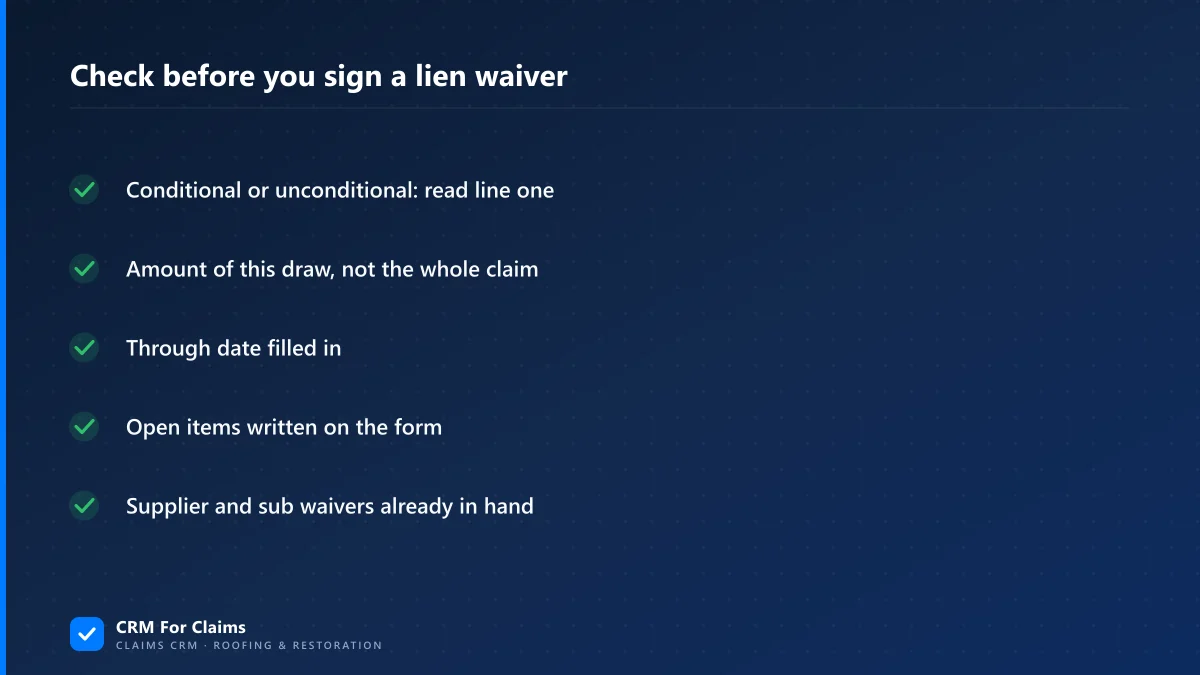
Whichever direction a waiver goes, these lines are filled in before anyone signs:
- The property
- The full address of the house, and the owner's name as it reads on the deed or the check.
- The amount
- The amount of this payment, or this draw, in numbers. Never blank, never the total of the claim on a progress form.
- The through date
- The last day of work this payment covers. Work after it stays protected.
- What stays open
- Write it on the form: the held-back depreciation, a supplement still with the carrier, a change order not yet paid. An exception written on the waiver is one nobody can argue about later.
- Your copy
- Signed and dated, kept on the claim with the payment it went with.
Keeping each waiver on the claim it belongs to
The waiver itself is simple. What goes wrong is not knowing, three weeks later, which waiver went with which check, and whether the lender still has your money. That is the part CRM For Claims keeps on the claim.
Each mortgage company in the directory has a Documents field for the papers that lender asks a contractor for, and a Files tab for its blank forms, so the waiver the desk wants is on file before the next packet arrives. On the invoice, the money's location can be set to Held by MORTGAGE COMPANY while the lender has it. Payment cleared on our bank account is the location at the other end, and that is the moment a waiver for that amount can safely become unconditional. The loss draft tracking page shows how the lender record and the money locations fit together.
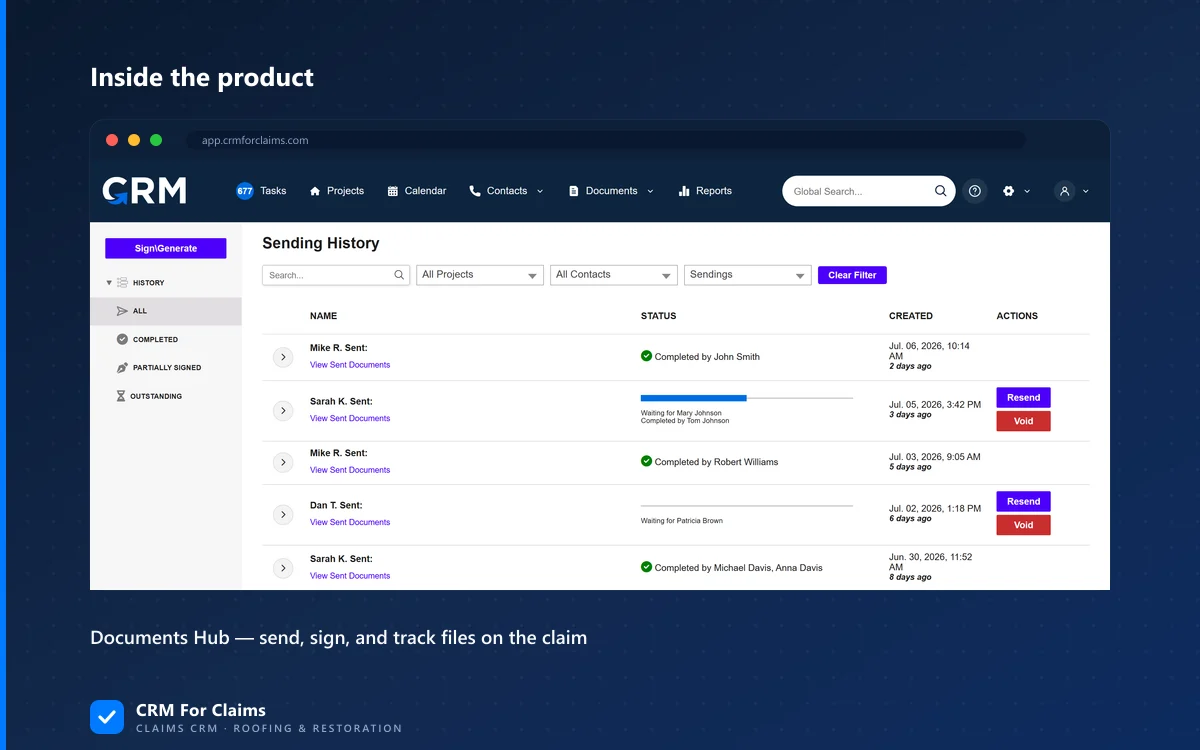
Your own waiver forms can live in the Documents Hub as templates. Send one for signature and the sending history shows it as Outstanding, Partially Signed or Completed. Set a Signed File Folder on the template and, when the waiver is sent from a claim, the signed copy is saved in that folder of the claim.
If a loss draft packet is sitting on your desk right now and you want to see the lender record, the invoice and the waiver template on a real screen, book a live walkthrough and bring the packet. The pricing page lists the plans, billed monthly with no contract.