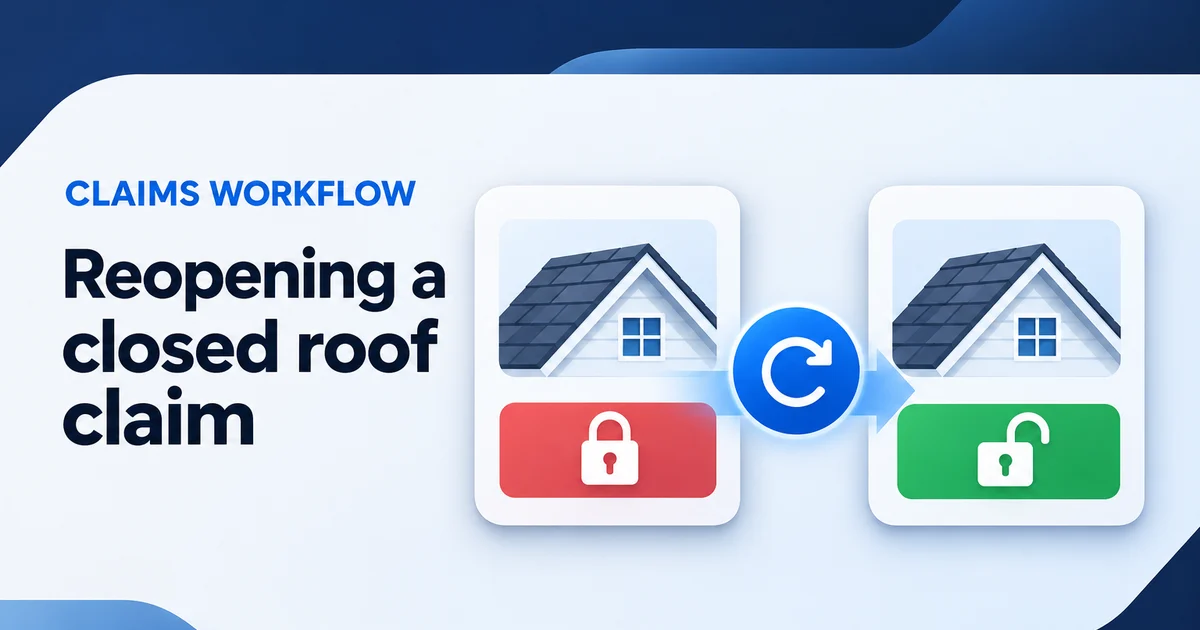
A closed roof insurance claim can usually be reopened, as long as you use the right door and you are still inside the clock. If the carrier already knew about the damage and paid short, or closed the file because nobody answered, the homeowner asks for the closed claim to be reopened. If you found more damage from the same storm, or the tear-off turned up costs nobody could see from the ground, that is a supplement. If the damage came from a different storm, it is a new claim with its own date of loss. Each door has its own deadline and its own evidence.
I build CRM For Claims, and the closed claim I see most often in roofing offices is not a lost argument. It is a file where the first check came, the job got built, and three months later someone notices that the depreciation never arrived, or that the interior stain the homeowner mentioned was never added. The letter says closed. The money is still out there.
What does a "claim closed" letter actually mean?
It means the carrier has stopped working on the file, not that the homeowner has given up any rights. Carriers send it after a payment, after a denial, and after a stretch of silence when they asked for something and got nothing back. A closed letter after silence is the easiest one to reverse: you find out what they asked for, you send it, and you ask for the file to be reopened.
Read the letter for the reason. "Closed, no response to our request for information" and "closed, paid in full per our estimate" are different problems, and the first one is usually fixed with paperwork, not a fight.
Reopen, supplement or a new claim: which one is yours?
Sort the problem by two things: whether the carrier already knew about this damage, and whether it came from the same storm. That decides the door.
Reopen the claim
- What you have
- Damage the carrier already knew about, paid short or not paid, or a file closed because a request went unanswered.
- What the carrier will ask
- What is new since the decision: a measurement, a photo, a report, a corrected date.
File a supplement
- What you have
- More damage from the same storm, or costs that showed up during the work, such as rotted decking or a second layer under the shingles.
- What the carrier will ask
- Proof it is the same loss: dated photos from the tear-off and the line items with quantities.
Open a new claim
- What you have
- Damage from a different storm, after the first claim's date of loss.
- What the carrier will ask
- A new date of loss, and how this damage differs from what was already paid.
The wrong door costs time. A new storm filed as a supplement gets pushed back because the date of loss does not match. Old damage filed as a new claim can collect a second deductible and a question about why it was not reported the first time. If you are not sure of the date, the post on pinning down the date of loss on a hail claim walks through the evidence.
How long do you have to reopen a roof claim?
As long as the policy and the state allow, and that varies. Florida is the clearest case because it writes the clocks into a statute, with separate deadlines for a reopened claim and a supplemental claim.
Florida Statutes, section 627.70132
A reopened claim is one the insurer has previously closed
and reopened at the insured's request for more money on loss or damage previously disclosed to the insurer
. Notice of it is due within 1 year after the date of loss, the same as a new claim.
A supplemental claim covers additional loss from the same peril the insurer already adjusted, or costs incurred while completing repairs. Notice is due within 18 months after the date of loss.
Source: The 2025 Florida Statutes, 627.70132, Notice of property insurance claim. Amended in 2021, 2022, 2023 and 2024, so check the year you are reading.
One example roof in Florida, date of loss April 10, 2026
An example date to show how the two clocks run, not a real claim.
Both clocks run from the date of loss, not from the day the letter said closed. On a claim filed late, that leaves far less time than people assume. A roof built in month eight leaves four months to get a reopening request in.
Outside Florida, start with the policy. Look at the duties after loss section for how notice must be given, and at the clause usually titled "Suit against us", which sets how long the homeowner has to sue and is often counted from the date of loss. Your state's insurance department publishes its own rules for how fast the carrier must answer, which I collected in the post on insurer response deadlines.
Who asks for the reopening, the roofer or the homeowner?
The homeowner. They are the insured, and the claim is theirs. In many states a roofer without a public adjuster license may not negotiate the settlement or speak for the homeowner on the claim, and the line moves from state to state. What the roofer can always do is supply the evidence: the dated photos, the measurements, the line items, and an inspection report. Where that line sits in each conversation with the carrier is in can a roofer talk to the insurance adjuster.
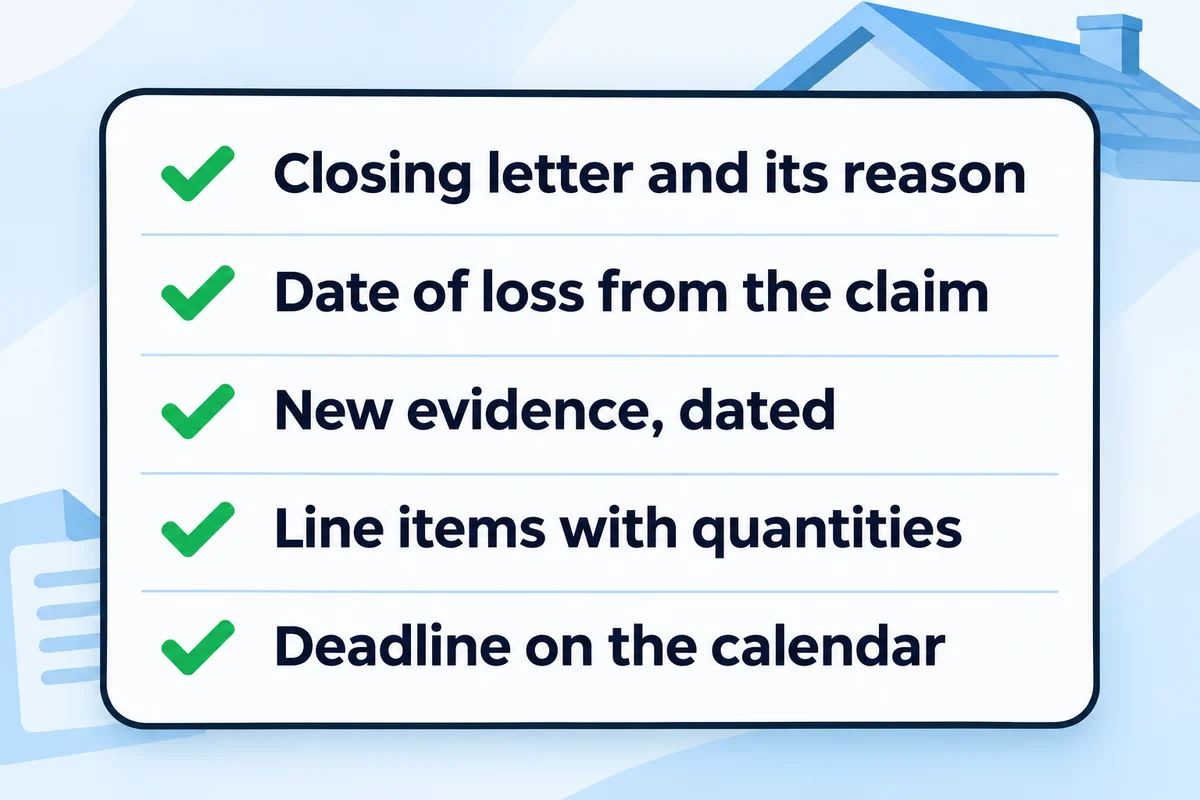
So the practical job in your office is to hand the homeowner a request that is complete and easy to send. A good one has five parts, and the note next to each part says why it is there.
Keep the tone flat. The person who reads it decides whether to put the file back in someone's queue, and a list of new facts gets there faster than a complaint. If the carrier still says no, the next steps are in what to do when a carrier denies the claim.
Keeping a closed claim findable in your CRM
Most reopenings fail before the letter: nobody can find the first-day photos, the date of loss was typed three different ways, and the person who ran the job has left. A closed claim should stay a working record until the last deadline passes.
In CRM For Claims, the claim status is a list on the claim screen with Claim Needs to be Filed, Filed, Approved, Denied and Closed, so a closed claim can be set back to Filed when the carrier reopens it. The date of loss is picked from a list of the storms your company saved, each shown with its date, so the reopening request and the original claim carry the same date. When the carrier pays on a supplement, the money goes on the project as its own invoice type, such as Supplemental ACV or Supplemental Recoverable Depreciation, instead of being folded into the first check. For the deadline itself, you add a task, assign it to one person and pick its due date from the calendar.
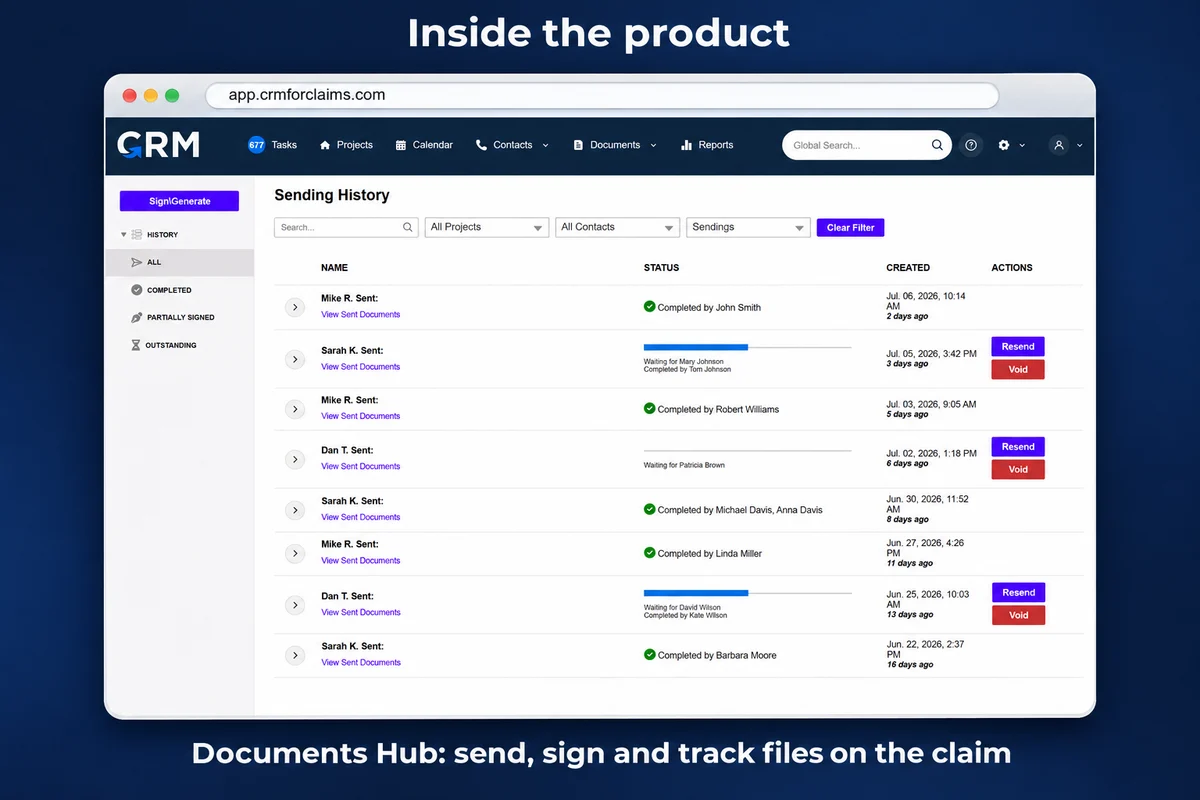
The full list of what the product does is on the features page. If you have a pile of closed files you suspect still owe money, book a live walkthrough and we will put one of them in front of you on screen.