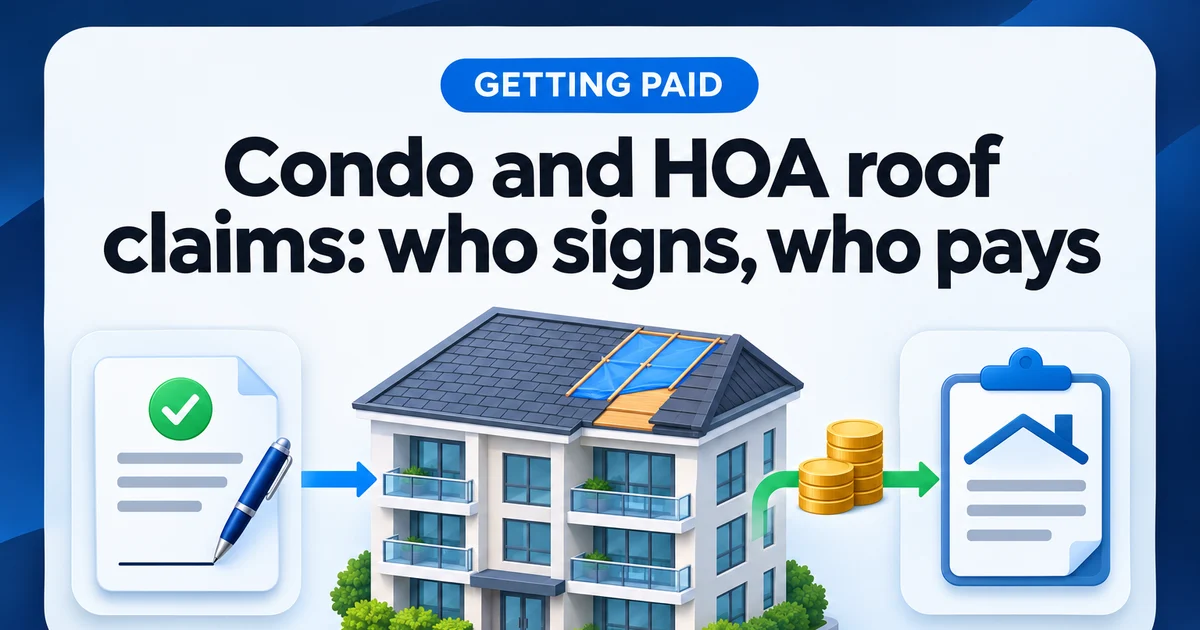
On a condo or HOA roof insurance claim, the association is usually your customer. Its board signs the contract, its master policy covers the roof, the carrier adjusts the loss with the association and makes the check out to it. The owner who flagged you down in the parking lot after the storm can tell you where the leak is. In most buildings they cannot sign for the roof over their unit.
I build CRM For Claims, a CRM for roofing and restoration teams that work insurance claims. Townhome rows and small condo buildings are good work after a hail storm: one roof, several units, one decision maker. They also go wrong in a very particular way. A rep gets a signature from an owner, the crew is booked, and two weeks later the property manager calls to say the board never hired anyone.
Who signs the papers on a shared roof?
The governing documents decide, but the usual answer is the board, through the person it names. Condo declarations commonly make the roof a common element, and townhome associations that insure the buildings often do the same. Before any paperwork, ask the manager for two things: the page of the declaration that says who maintains the roof, and the declarations page of the master policy. Those two pages tell you who your customer is.
When the association owns the roof, the usual roof-claim paperwork lines up like this, next to a detached house.
| Document | Single-family house | Condo or HOA building |
|---|---|---|
| Contract or claim authorization | The homeowner | The board or its manager, as the governing documents allow |
| Claim filed with | The homeowner's own policy | The association's master policy |
| Meeting the adjuster | The homeowner, with you on the roof | A board member or the manager, with you on the roof |
| Certificate of insurance | Only if the homeowner asks | Required in Illinois above $10,000 a year, naming the association, board and manager |
| Insurance check made out to | The homeowner, often with the mortgage company | The association, or an insurance trustee it names |
| Certificate of completion and lien waivers | The homeowner signs and receives them | The association signs and receives them |
The last row matters more than it looks. If you are used to handing a certificate of completion to the homeowner at the kitchen table, on an association job it goes to the manager, and so do the lien waivers for each payment.
What the Illinois condo law says about the claim money
Illinois puts it in writing. Section 12 of the Condominium Property Act sets the insurance a condo association must carry, and subsection (g) settles who deals with the carrier and who gets paid. Other states have their own condo acts, so read yours, but the Illinois text is a clean example of the logic.
765 ILCS 605/12(g), adjustment of losses and distribution of proceeds
- 1
Any loss covered by the property policy under subdivision (a)(1) must be adjusted by and with the association.
The adjuster settles the roof with the association. A unit owner cannot agree a scope for the building on their own, and neither can you on their behalf. - 2
The insurance proceeds for that loss must be payable to the association, or to an insurance trustee designated by the association for that purpose.
Your invoice goes to the association, and so does the check. You are not chasing twelve owners for twelve signatures. - 3
Unit owners are not entitled to receive any portion of the proceeds unless there is a surplus of proceeds after the common elements and units have been completely repaired or restored
The money is for the repair first. That is good news for the roofer: the law points the check at the work.
The same section, subsection (i), is where the certificate of insurance comes from: contractors with contracts over $10,000 a year with a condo association "must provide certificates of insurance naming the association, its board of directors, and its managing agent as additional insured parties." Ask your agent for that certificate when you send the proposal, not when the crew is already on the truck.
Who pays the deductible on a condo roof claim?
In Illinois the board chooses, from three options the statute lists in subsection (c). It can pay the deductible as a common expense, charge it after notice and a hearing to the owners who caused the damage or whose unit it started from, or make the owners of the affected units pay it. On a large deductible, that choice decides whether an owner pays a small share or a big one.
Take one example building, worked through with round numbers. It has twelve units, the top four sit under the damaged roof, and the master policy deductible on this example claim is $25,000. These are not figures from any real association.
One $25,000 deductible, three ways to charge it
Each bar is one unit's share, drawn to the same scale.
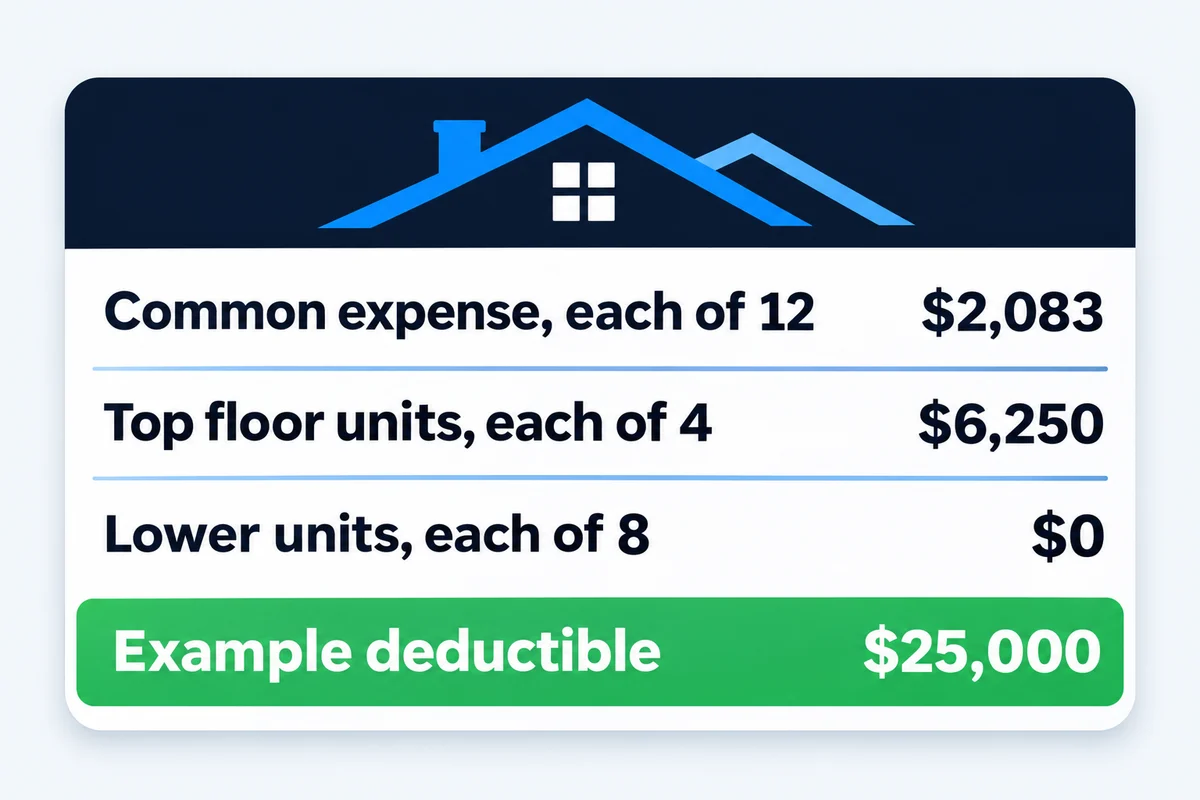
Two things follow for the roofer. First, the deductible is the association's to collect from its owners, the same way the check is the association's to receive. Your contract and your invoice show it as one line owed by the association. Second, an owner on the top floor who hears "$6,250" is going to ask you about it. The honest answer is that the board decides, under the declaration and the statute, and you can show them the line on the estimate. It is not a number you can make go away. Waiving or absorbing a deductible is a separate legal question, and I wrote about what a contractor can and cannot do with a deductible before.
The order of an association roof job, from first call to final check
An association job takes more calendar time than a house, mostly because a board meets on a schedule. This is the order that keeps the file clean.
The manager asks for an inspection
Get the request from the manager or a board member in writing, even an email. A text from a single owner is a lead, not an authorization.
Emergency work, if water is coming in
Illinois lets a board act on an emergency, defined as "an immediate danger to the structural integrity of the common elements or to the life, health, safety or property of the unit owners", and ratify it afterwards, with notice to owners within 7 business days (605/18(a)(8)(iv) and (a)(21)). A tarp still needs a signature from someone who speaks for the board. More on who pays for an emergency tarp.
The board hears you
Board meetings are open to owners, but the board may close a portion to interview a provider of goods and services. The vote itself has to happen in the open part. Bring the inspection photos and a scope, not a pitch.
The association files the claim
The claim goes on the master policy under the association's name. Write down the claim number, the policy number and the carrier the day it is filed.
The adjuster walks the roof
A board member or the manager meets the adjuster. You can be on the roof to point at damage, within what your state allows a contractor to say.
The contract and the certificate of insurance
The board signs, and you deliver a certificate naming the association, its board and its manager as additional insureds.
The work, then the paperwork
Completion certificate, final invoice and lien waivers go to the association. The check comes from the association, or from its insurance trustee.
Where the unit owner's own policy still comes in
The owner who called you is not out of the picture. Their own condo policy, usually called an HO-6, covers what the master policy leaves out, and the same storm can start a second, separate claim for them.
Association's master policy
- The roof and other common elements
- That means the shingles, decking, flashing and gutters of the building.
- The bare walls, floors and ceilings of units
- Illinois requires this cover unless the board decides otherwise.
Unit owner's own policy
- Improvements and betterments
- What the owner added inside the unit. The statute says the master policy "need not cover" these.
- Floor, wall and ceiling coverings
- The Illinois act leaves them out of the common elements.
Keep the two claims apart in your records. They have a different carrier, a different policy number and a different person who signs. If you mix the interior ceiling repair into the association's roof file, someone will be paid twice or not at all.
Keeping an association claim straight in the CRM
None of this needs a special module. It needs the right person on the claim and the right numbers in the right fields from the first day.
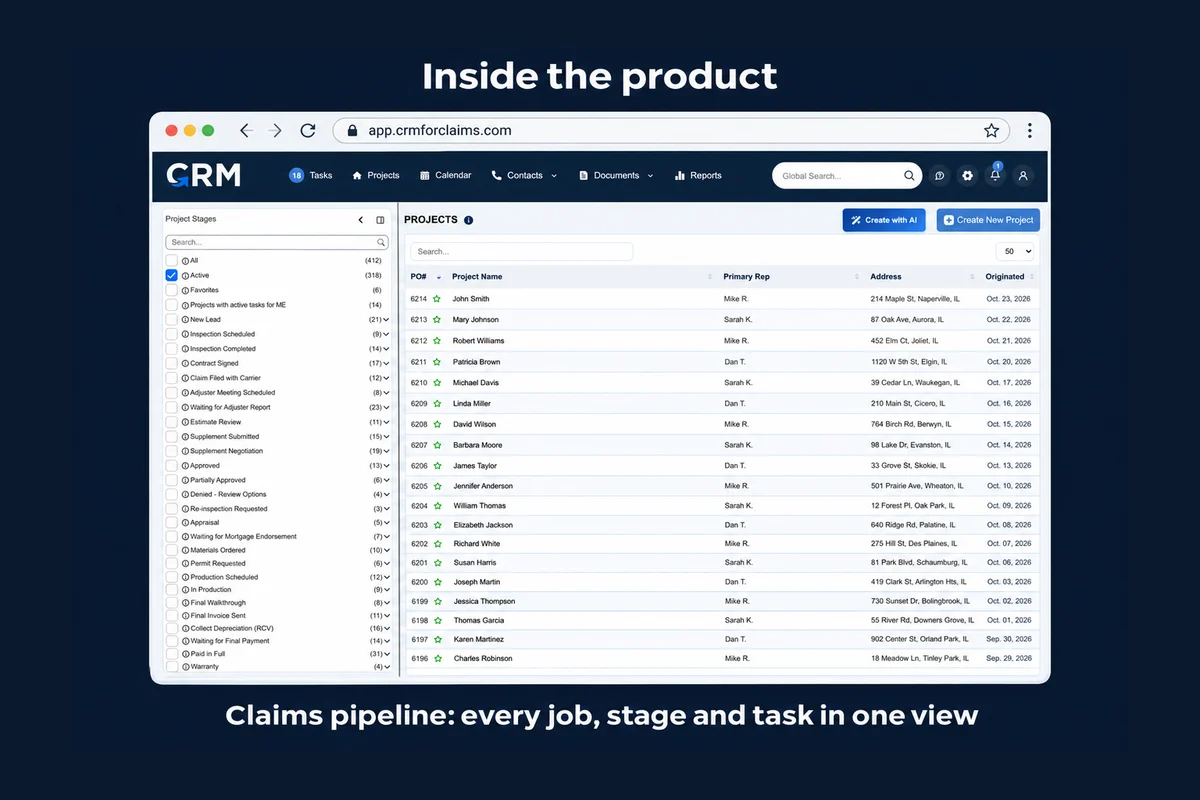
In CRM For Claims, the claim screen holds the insurance company account and the insurance policy number, so the master policy is recorded as the association's policy and not the owner's. The deductible amount has its own field, and there is a separate field for a hail and wind deductible. The field adjuster is recorded on the claim. So is the inside adjuster. When the board decides how the deductible is charged, the Deductible invoice type puts it on the project as its own line. And every step of the track above, from the board meeting date to the certificate of insurance, can be a task assigned to one person with a due date. You can see the rest of what the claim screen does on the features page.
If your team is starting to pick up townhome and condo work and you want to see how an association claim would sit in the system, book a live walkthrough and bring one of your real buildings as the example.