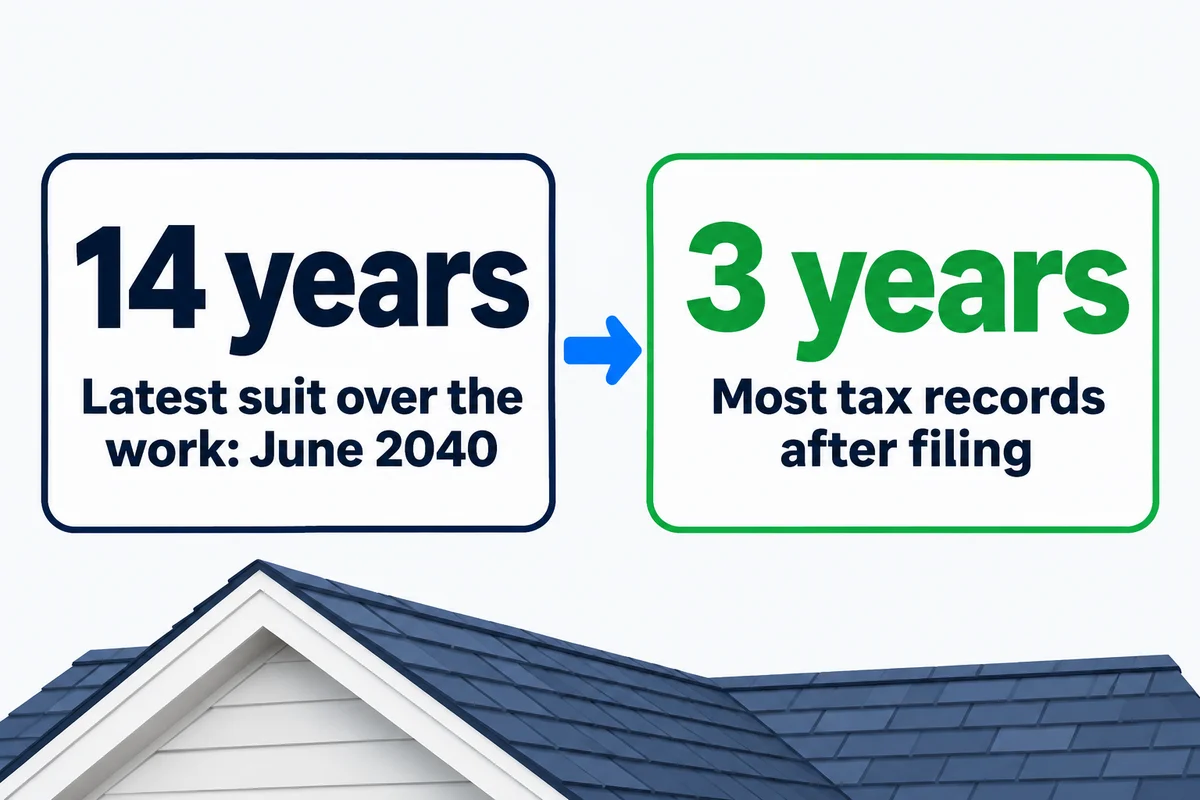
A roofing company should keep job records for as long as anyone can still bring a claim over the work, and in Illinois that is up to 14 years after the roof is finished, longer if you sold a workmanship warranty that runs past that. Tax records follow a shorter federal clock, usually 3 years after you file the return. So the honest answer to how long a roofing company should keep job records is two schedules: one for the money paperwork and one for the job file itself, and the job file is the one that lives longest.
I build CRM For Claims, software for roofing and restoration companies that run insurance claims, and the question I hear at year end is always the same one: the storage unit is full, the shared drive is a mess, can we throw out 2019? This post reads the four laws that decide it, walks one Illinois roof from the day it was finished to the last day it can be sued over, and ends with a table you can turn into your own policy. I quote Illinois because that is where we are. Your state has its own numbers, so look them up before you shred anything.
Four clocks run on every roof you finish
No single rule says "keep it seven years." Different laws start different clocks on the same job, and the file has to outlive the longest one that applies to you.
Federal tax
Records that back up income or a deduction stay until the IRS can no longer change that return: 3 years after filing in the normal case, 6 if more than 25% of gross income went unreported, 7 if you deducted a bad debt. Payroll tax records: at least 4 years after the tax was due or paid.
Source: IRS, How long should I keep recordsClaims over the work
In Illinois a suit over construction work must be filed within 4 years of when the owner knew or should have known of the problem, and never more than 10 years after the work. Someone who finds the problem before year 10 still gets at least 4 years from then.
Source: 735 ILCS 5/13-214Written contracts
Actions on a written contract in Illinois have 10 years from when the cause of action accrued. That cuts both ways: a homeowner's claim under your contract, and your own claim for an unpaid balance.
Source: 735 ILCS 5/13-206Safety and lead paint logs
The OSHA 300 log, summary and 301 forms stay for 5 years after the calendar year they cover, if you had more than 10 employees that year. Work that disturbed paint on a house built before 1978 needs its lead-safe records for 3 years after the job.
Sources: 29 CFR 1904.33, 40 CFR 745.86The construction statute is the one most roofers have never read past the headline number, and one sentence in it matters to anyone who sells long warranties:
"Subsection (b) shall not prohibit any action against a defendant who has expressly warranted or promised the improvement to real property for a longer period from being brought within that period."735 ILCS 5/13-214(d), Illinois Code of Civil Procedure
In plain words: the 10-year cutoff does not shield you from your own promise. If the contract says 25 years on workmanship, a homeowner can bring that warranty to court inside those 25 years, and you want the file that shows what you installed and how.
One Illinois roof, followed to the last possible day
Take a hail claim roof the crew finished on June 15, 2026, paid in full, closed out in the CRM the same month. Say the company files its 2026 return on its April 15, 2027 due date, had 14 people on payroll that year, sold the homeowner a 25-year workmanship warranty, and replaced painted fascia boards on a 1968 house. Here is when each piece of the file stops being needed:
- Roof finished. Every clock that counts from the work starts today.
- The lead-safe paperwork for the fascia work can go: test results, the pamphlet receipt, the certified renovator's records.
- 3 years after the 2026 return was filed. The receipts and invoices behind that year's income and expenses are no longer needed for tax, as long as nothing went unreported and no bad debt was deducted.
- The 2026 OSHA 300 log and 301 forms reach the end of their 5 years.
- 10 years since the work. Without a longer warranty, a problem first found after today could no longer be taken to court over the work.
- The latest day a suit over the work can be filed: a homeowner who found a leak on June 14, 2036, one day before the cutoff, still gets 4 full years.
- The 25-year workmanship warranty ends. Under subsection (d), this is the real end date for this file.
Notice which dates come first. The tax paperwork is free to go in 2030, and that is the number most office managers have in their heads. The job file, the one that proves how the roof went on, has to be findable for another decade at least. If the company had sold a 10-year workmanship warranty instead, the file would still need to last to June 2040.
How long should a roofing company keep each document?
Sort the paperwork by the clock that governs it, not by where it happens to sit. A signed contract is a tax record, a contract record and evidence about the work at once, so it takes the longest of the three. This is the schedule I would start from for a roofing company in Illinois:
| Document | Keep until | The clock behind it |
|---|---|---|
| Signed contract, contingency agreement, change orders | Completion + 14 years, or the warranty end if later | Construction statute and its warranty sentence |
| Inspection report, before, during and after photos | Completion + 14 years, or the warranty end if later | The only proof of what was there and what you installed |
| Insurance scope, supplements, adjuster correspondence | Completion + 14 years | A dispute over the work usually reaches back to what was approved |
| Permit, inspection sign-offs, certificate of completion | Completion + 14 years | Shows the work passed the town's inspection when it was done |
| Manufacturer warranty registration, material invoices | End of the manufacturer warranty | The manufacturer will ask what was bought and when |
| Invoices issued, payments received, expense receipts | 3 years after that year's return is filed | IRS, 7 years if a balance was written off as bad debt |
| Payroll records | 4 years after the tax was due or paid | IRS employment tax rule |
| OSHA 300 log, 300A summary, 301 forms | 5 years after the end of that calendar year | 29 CFR 1904.33, if you had more than 10 employees |
| Lead-safe renovation records, pre-1978 homes | 3 years after the job | 40 CFR 745.86 |
The 14 years in the table is the Illinois 10 plus 4. It is my reading of the statute for planning purposes, not legal advice, and the exceptions in the same section (fraud, a claimant who was a minor) can stretch it further. Keeping a closed job file a year past its line costs a few megabytes. Throwing it out a year early can cost the whole case.
What a closed claim file is for, years later
Lawsuits are the reason the law gives, but they are not why a roofing office actually goes back into old files. These are the calls that send someone digging, and each one needs a different part of the file:
- The next storm hits the same roof
- The new adjuster sees prior work and asks what was replaced last time and what was not. Your final photos and the approved scope answer it in five minutes. Without them, the homeowner's new claim can stall on "pre-existing damage."
- The house is sold
- The buyer's inspector or the seller's agent asks for the roof's age, the permit and the warranty. A certificate of completion and the permit record from the job turn a vague "about eight years old" into a document. The post on the roof certificate of completion covers what that one should say.
- A warranty call comes in
- Was it workmanship, a material defect or a new loss? The answer depends on what you installed, where, and when. The warranty callbacks after a claim closes post walks through sorting those calls.
- An old balance turns into a write-off
- If the homeowner never paid the last invoice and you deduct it as a bad debt, the IRS clock on those records becomes 7 years. The invoices, the payment history and the collection letters are the proof.
A yearly purge that does not lose anything you need
Retention only works if something actually gets deleted on a schedule. Otherwise it is just hoarding with a policy attached. Once a year, on a date you pick, the office runs the same short routine:
- Check for anything open first. A lawsuit, a demand letter, an appraisal, a complaint to the state or a warranty dispute puts that whole file on hold, whatever the table says. Nothing on hold gets touched until it is resolved.
- Pull the list of jobs finished in the year that just crossed its line, and the tax year that just crossed its 3 years.
- For each job, check the warranty term on the signed contract. A warranty that outlives the statute moves the job file to the warranty's end date.
- Delete or shred what is past its date, and write down what went and when. A written routine you followed is far easier to defend than a box that went missing.
- Spot-check that what stays is still readable: photos open, PDFs are not corrupted, nothing lives only on a laptop that left with a former employee.
If your files are named and filed the same way on every job, step 2 takes minutes instead of a weekend. The post on claim file naming conventions is the groundwork for that.
Where the file lives in CRM For Claims
In CRM For Claims every project comes with folders for the Insurance Policy, the Permit, the Project Contract Documents, the Labor Warranty Documents and the Building Materials Warranty Documents, so the pieces in the table above each have a place on the claim. When a carrier, a buyer's inspector or a lawyer asks for the file, you tick the files in a project and combine all selected files into one PDF and download it.
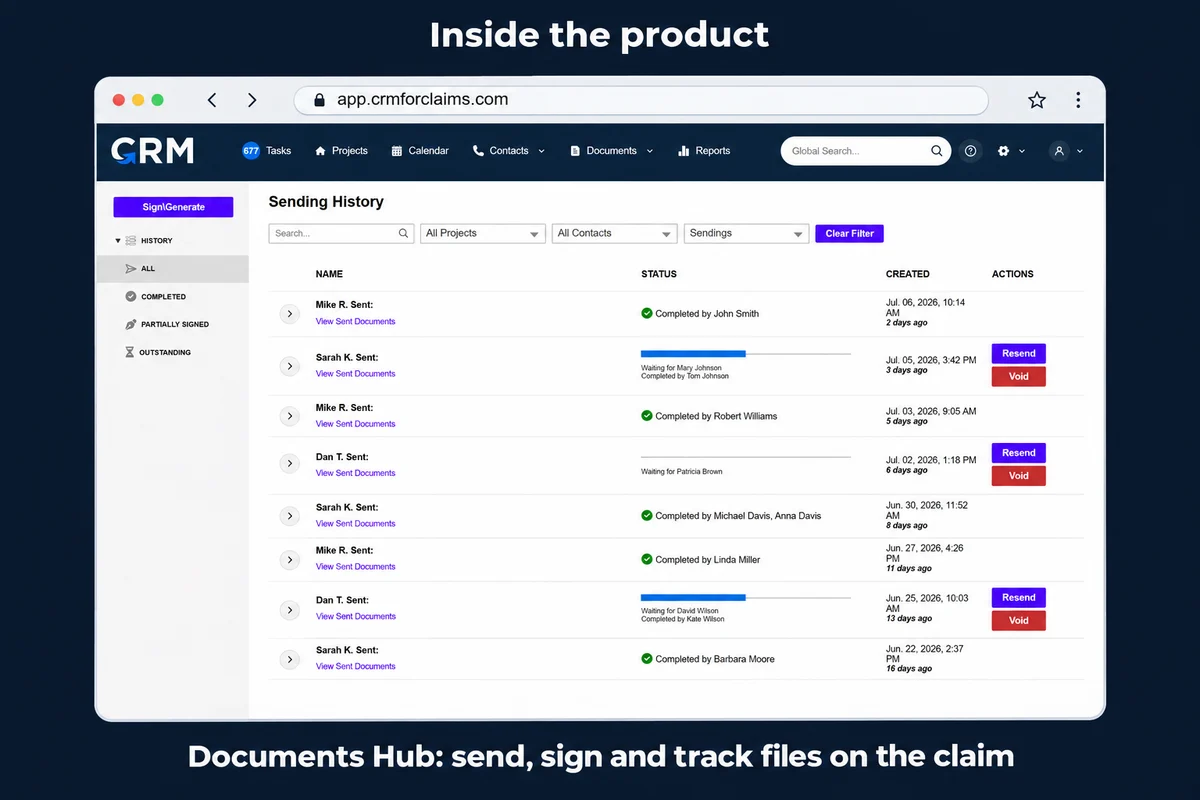
A document signed in the Documents Hub is not destroyed when someone on the team presses Delete on it: it is moved to an archive that keeps it for 7 years, together with its SHA-256 fingerprint. That covers the most common way a signed contract disappears, which is not a fire or a flood but a well-meaning cleanup.
The rest of the claim workflow is on the features page, and the plans with the per-user price are on pricing. If your old job files are spread over a drive, a filing cabinet and three phones, book a live walkthrough and I will show you where each document from the table would sit on a demo claim.