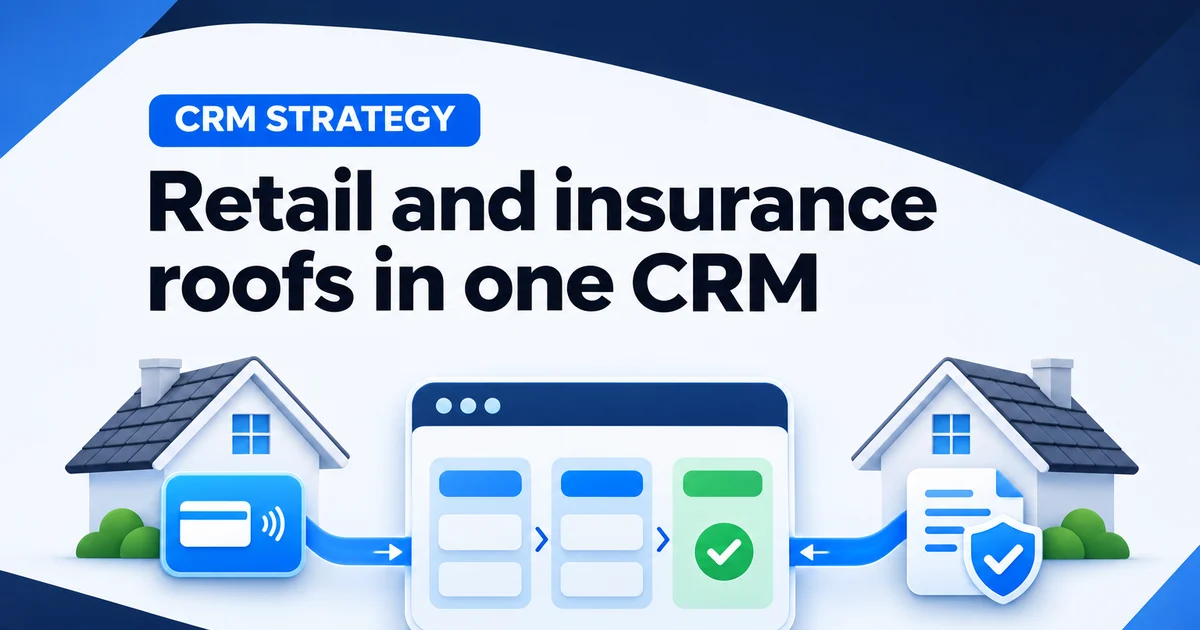
You can run retail and insurance roofing jobs in one CRM, and you should: one customer record, one property, one set of photos, one crew calendar. What you split is everything that depends on who pays. A cash roof has one payer and a price the homeowner agrees to. A claim roof has a carrier that approves the price, often a mortgage company on the check, and money that arrives in pieces over months. Keep those two lanes apart in stages, invoices and reports, and keep the person and the house in one place.
I build CRM For Claims, a CRM for roofing and restoration companies that run insurance claims. Most of the companies I talk to do both kinds of work, and the mess I see is rarely the claim itself. It is the house that started as a claim and finished as a cash job, filed twice, with the photos in one record and the money in the other.
What stays shared and what splits
Share the things that belong to the house and the people; split the things that belong to the payer. If you are unsure about a field, ask one question: would it be different if the carrier paid instead of the homeowner? If yes, it splits.
One record for both lanes
- The homeowner, their phone and email, and everyone else on the household.
- The property address and roof details: pitch, layers, age, measurements.
- Inspection photos and notes. A claim inspection today is the sales inspection of next year's cash roof.
- The crew calendar, material orders and the permit.
- Every text, email and signed document, kept on the job.
Kept apart by lane
- Stages. A claim waits on an adjuster; a cash job waits on a signature.
- The contract. A contingency agreement for the claim, a sales contract for the cash roof.
- Who approves the price and who pays it.
- Invoice types, so a deductible is never booked as a down payment.
- Reports: close rate, days to paid, average ticket, money still out.
The mistake I see most is the opposite setup: two separate systems, or two copies of the customer, one per lane. It feels tidy for a month. Then a homeowner whose claim you worked two years ago calls about a leak, and the office finds a contact with no history because the history lives on a record nobody searched. One customer record avoids that, and it is the reason a CRM built for roofing contractors should hold both kinds of job instead of pushing the cash work into a spreadsheet.
Where a retail roof and a claim roof part ways
They start the same and part at the contract. Lead, appointment and inspection look alike on both. From the signature on, a cash roof moves at the speed of the homeowner and your crew, and a claim roof moves at the speed of the carrier. Lay the two side by side and the fork is easy to see:
| Step | Cash (retail) roof | Insurance claim roof |
|---|---|---|
| First contact | Homeowner wants a new roof | Homeowner reports storm damage |
| Inspection | Measure and price | Measure, photograph damage, pin down the date of loss |
| Paper signed | Sales contract with your price | Contingency agreement, price set later by the approved scope |
| Who sets the price | You and the homeowner | The carrier's adjuster, then supplements |
| Waiting on | Deposit and material delivery | Adjuster visit, estimate, first check |
| Payments | Down, maybe progress, final | First check, deductible, depreciation after completion |
| Closing paper | Final invoice and lien waiver | Certificate of completion, final invoice, depreciation release |
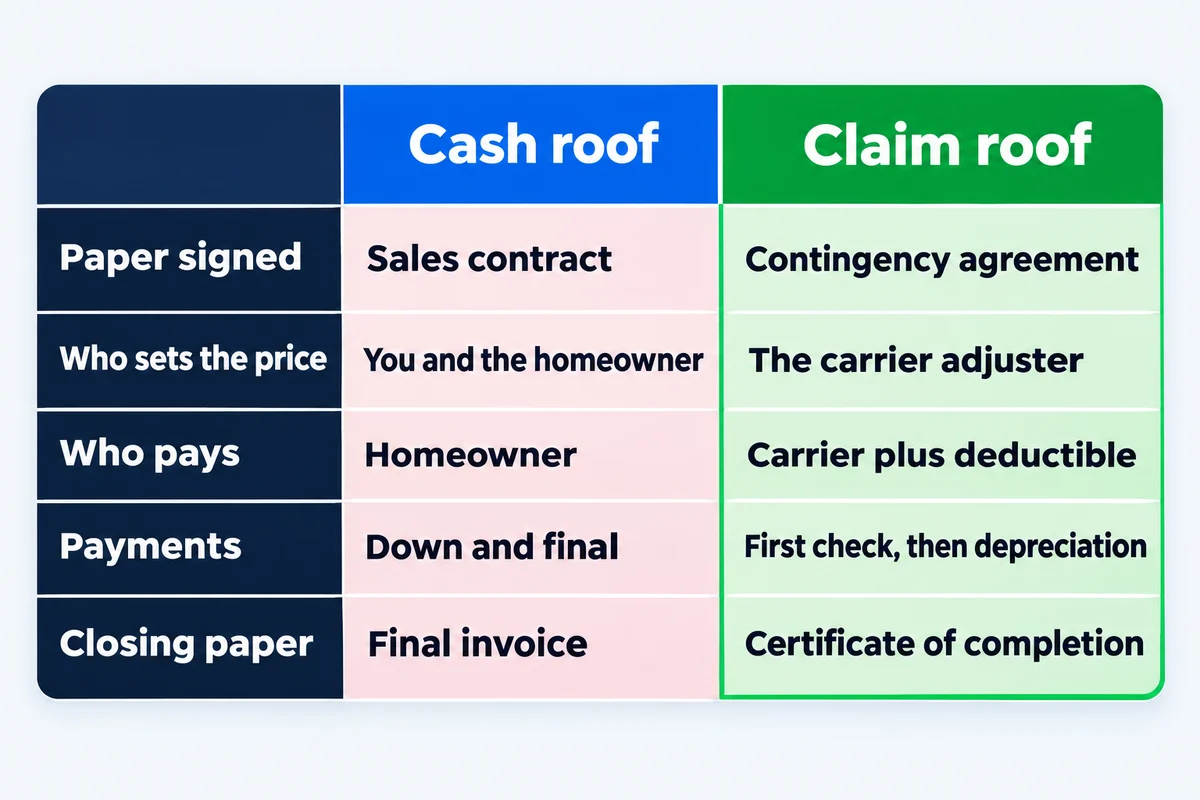
Every row below the inspection is a different stage, a different document and a different reason the job sits still. That is why one pipeline for both lanes fails: a cash job parked in "waiting on adjuster" makes no sense, and a claim parked in "waiting on deposit" hides the real hold-up. I made the longer case for stages over sales steps in why claim jobs need a pipeline, not a sales funnel.
The roof that changes lanes
A mixed book always has jobs that sit in both lanes at once, or move from one to the other. These are the jobs that break a CRM set up as two worlds. Two common shapes, with example numbers:
Approved claim plus an upgrade
The carrier approves the roof. The homeowner wants a heavier designer shingle the scope does not include. One job, two payers.
| Carrier, first check (ACV) | $10,900 |
| Homeowner, deductible | $1,500 |
| Carrier, depreciation after completion | $1,800 |
| Homeowner, shingle upgrade (retail) | $2,300 |
| Job total | $16,500 |
Denied claim that becomes a cash roof
The carrier denies the claim as wear and tear. The roof is still old, and the homeowner decides to replace it with their own money.
| Carrier, claim denied | $0 |
| Homeowner, down payment (retail) | $4,000 |
| Homeowner, final payment (retail) | $9,600 |
| Job total | $13,600 |
In the first case the upgrade is a sale of its own. It gets its own line, its own price and its own invoice type, and it never borrows money from the claim lines. That matters for more than tidy books. Pricing the upgrade so that the deductible quietly disappears is the oldest trick in storm work, and in many states it is against the law. The Texas Department of Insurance puts it plainly on its consumer page:
Some contractors might offer rebates or credits in the amount of your deductible. That's also illegal.Texas Department of Insurance, Can a contractor waive my deductible? (last updated 12/9/2025)
When the deductible and the upgrade sit on separate lines, anyone reviewing the file can see the homeowner paid both. I wrote more about the state rules in what contractors can and cannot do with a deductible.
In the second case, do not delete the claim and start a new customer. Keep the denial letter, the inspection photos and the adjuster's notes on the job, and move the job into your retail stages. If the carrier reopens the claim after a reinspection, the evidence is still there. And your reports stay honest: one claim lost, one cash roof won, from the same house.
Reports: never blend the two lanes
A number that mixes cash roofs and claim roofs describes neither. Each lane gets its own line, and the total sits under both. These four go wrong first when they are blended:
Close rate
Storm leads sign contingency agreements at a different rate than people shopping for a cash roof. Blend them and a good storm month makes a weak sales team look fine.
Days from signature to paid
A cash roof can be paid within weeks. A claim waits for depreciation after the work. One average across both tells you nothing about either.
Average ticket
Claim roofs carry code items and supplements; cash roofs carry upgrades. Compare each with its own lane from last year, not with each other.
Money still out
Unpaid retail balances are a collections job. Unpaid claim money is often a document the carrier is waiting for. Same dollar figure, different person to chase it.
If you already track the money side on a spreadsheet, this split is usually the first thing that falls apart there, because the sheet has one column for "amount". The reports and KPIs in CRM For Claims add insurance income and retail income as separate totals before they add them together.
A three-job test before you trust the setup
Whatever CRM you use, run three test jobs through it before your team does. If any of them needs a workaround, fix the setup first.
- A plain cash roof: contract, down payment, final payment. Check that it never asks for a claim number or an adjuster.
- A claim with an upgrade: first check, deductible, depreciation, plus an upgrade the homeowner pays. Check that the upgrade shows as retail money and the deductible as insurance money.
- A denied claim turned cash: the claim record stays with its photos and denial, the job moves to retail stages, and your claim report counts it as lost while your retail report counts it as won.
How CRM For Claims keeps the two lanes apart
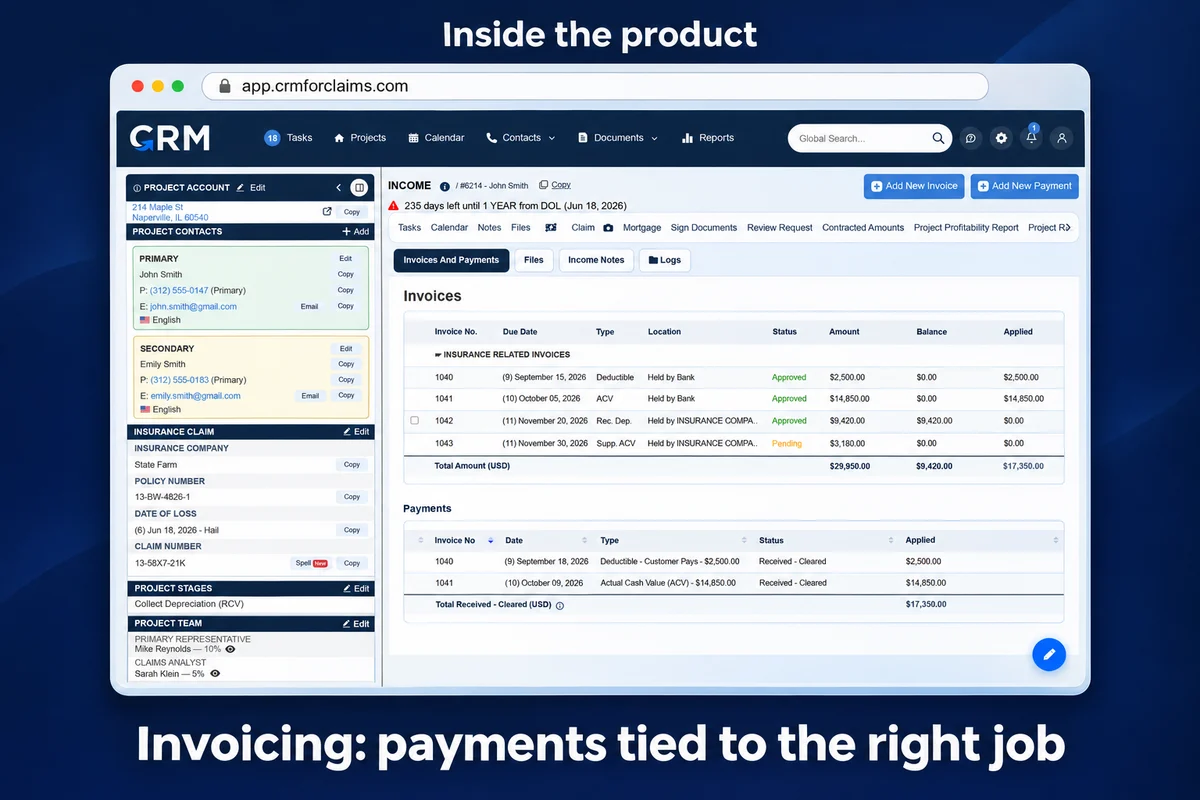
When you create an income invoice on a project, the invoice types come in two groups, insurance related and retail related.
The retail group has a down payment, a progress payment, a final payment and a bank financed payment.
The insurance group holds the claim money: actual cash value, recoverable depreciation, the deductible, and supplement and appraisal amounts.
You cannot pick an insurance invoice type until the claim information is filled in on the project, so a cash job never gets claim lines by mistake.
On the project, retail invoices are listed under their own heading, apart from the insurance invoices.
The project KPI view shows total insurance income and total retail income on separate lines, then the total of both.
Company-wide, the Master Report on the KPI page lists retail approvals on their own line, next to supplemental and appraisal approvals.
When a retail invoice is created, the CRM adds a task to collect the payment from the customer, due in 14 days.
The rest of what the CRM does is on the features page, and plans are on pricing. If you run both kinds of roofs and want to see your own mix set up, book a live walkthrough and bring one job of each kind.