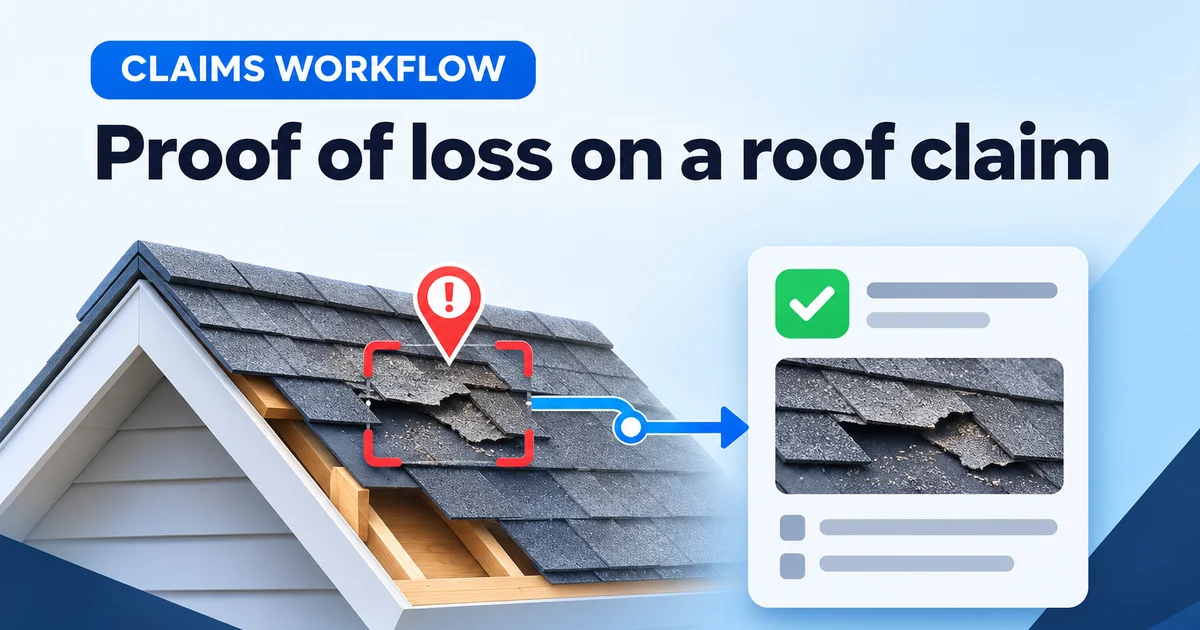
A proof of loss on a roof claim is a sworn statement the homeowner signs and sends to the insurance company, saying when and how the roof was damaged and how much they are claiming. The homeowner signs it, not the roofer. But most of the numbers on it come out of the roofer's file: the date of loss you recorded, your inspection photos, your estimate and your contract price. So the roofing office should know what the form asks for, have those papers ready, and write down the day the form went in.
I build CRM For Claims, software for roofing and restoration companies that run insurance claims. Proof of loss is one of those steps that nobody owns: the carrier sends the form to the homeowner, the homeowner calls the roofer, and the office hunts through email for the estimate. This post goes through the form line by line, the deadlines I could read on official pages today, one Illinois date that most offices never record, and the packet to hand the homeowner.
Proof of loss or the first claim call?
They are two different steps. The first call or online report opens the claim. The proof of loss comes later, often after the adjuster has been on the roof, and it is the homeowner's formal, signed statement of what was lost and for how much. The California Department of Insurance puts it in one line in its guide for homeowners:
Proof of loss is a formal statement made by a policy owner to an insurer regarding a loss. It is intended to provide the insurer with information to determine the extent of its liability.From the California Department of Insurance residential property claims guide
Not every carrier asks for one on every roof. Many settle a hail claim on the adjuster's estimate and never send the form. When the form does arrive, it is usually because the claim is large, disputed, or about to be paid, and it comes with a date attached.
What goes on the form, and who has the answer
Each carrier prints its own form, but the items come from the policy. California writes them into law in its standard fire policy, Insurance Code section 2071, which is the base for homeowners policies there. The proof must state, in the homeowner's "knowledge and belief", a list of facts, and the main ones are in the left column below. The other two columns are the part nobody else writes down: who can actually answer each line, and what from a roofer's file backs it up.
| What the form asks | Who can answer it | What backs it from the roofer's file |
|---|---|---|
| Time and origin of the loss | Both | The storm date you recorded at the first inspection, and the hail or wind report you tied it to |
| Interest of the insured and of all others in the property | Homeowner | Only the mortgage company name if it was already on the first carrier check |
| Actual cash value and amount of loss | Roofer's papers | The carrier's estimate, your own estimate or supplement, and the contract price |
| All encumbrances on the property | Homeowner | Nothing; this is the mortgage and any liens, which the homeowner knows |
| All other insurance covering the property | Homeowner | Nothing |
| Changes in title, use or occupancy since the policy began | Homeowner | Nothing |
| Verified plans and specifications, if required and obtainable | Roofer's papers | Measurement report and material list; the same policy lets the carrier ask for bills and invoices too |
Read the table from the right. Four lines are the homeowner's life, and you should not guess at them. Three lines are your work. That split is the whole job of the office here: hand over your papers cleanly, and let the person who signs under oath fill in what only they know. Where a roofer may help and where it starts negotiating the claim is a question of state law, and I went through it in where the line is when a roofer talks to the adjuster.
How long the homeowner has to send it
The policy sets the deadline, and 60 days is the usual number, but the day it starts counting differs. California's standard policy counts from the loss itself: the insured has to send it "within 60 days after the loss, unless the time is extended in writing by this company." Many homeowners policies elsewhere count from the day the carrier asks for it. Open the homeowner's policy, find the section called Duties After Loss, and read which of the two it is.
The date of the carrier's request is worth catching for a second reason. In Texas, Insurance Code section 542.055 says that by the 15th day after notice of a claim, the insurer has to "request from the claimant all items, statements, and forms that the insurer reasonably believes, at that time, will be required." Then, under section 542.056, it has 15 business days after it receives all of them "to secure final proof of loss" to accept or reject the claim in writing. The day the last paper lands starts the carrier's clock. If you want every one of those carrier clocks in one place, I laid them out in how long insurance has to respond to a roof claim.
California's same policy also says the loss "shall be payable 60 days after proof of loss" is received and the amount is agreed or awarded. So the proof is not paperwork for its own sake. On a disputed roof it is often the document that starts the money moving.
The Illinois date that stops the clock to sue
Most homeowners policies limit how long the insured has to sue the carrier, often a year or two from the loss. Illinois pauses that limit while the claim is being decided, and the pause starts on the day the proof of loss is filed. The statute, 215 ILCS 5/143.1, says it this way:
the running of such period is tolled from the date proof of loss is filed, in whatever form is required by the policy, until the date the claim is denied in whole or in part.Illinois Insurance Code, section 143.1
"Tolled" means paused. The strip below shows it on one example hail roof, with a policy that allows two years to sue. The dates are made up to keep the math easy; the rule is real.
Example Illinois roof claim: 56 days added to the deadline to sue
- June 2, 2026
- Hail. The two-year limit starts.
- August 10, 2026
- Homeowner files the sworn proof of loss. The clock stops.
- October 5, 2026
- Carrier denies part of the claim. The clock starts again.
- July 28, 2028
- Last day to sue, instead of June 2, 2028.
Those 56 extra days exist only if someone can prove when the form went in. On most roofs nobody ever sues, and that is fine. But on the one claim that ends in appraisal or with an attorney, the first question will be "when was the proof of loss filed?", and the answer has to be a date with a delivery receipt, not "sometime in August". The homeowner's attorney will ask the roofer's office, because that is where the file lives.
The amount line: a final number or a number known to date
The amount is the line that gets a claim into trouble, because it is sworn. A number the homeowner cannot back up can be called a misrepresentation, and a number lower than the real loss can be used against them later. There are two honest ways to fill it in, and the choice depends on whether the roof is settled.
The roof is agreed
Amount of loss claimed: $18,400.00, per the carrier's estimate dated September 22, 2026.
Use it when the carrier's scope and your contract match and no supplement is open. The number points at a document both sides already have.
Work is still open
Amount of loss claimed to date: $18,400.00. A supplement for items found at tear-off is being prepared and will be sent.
Use it when you expect rotted decking, a second layer or code items at tear-off. It states what is known and says plainly that more is coming.
Either way, the figure comes from a document, never from memory. If your estimate and the carrier's differ, the homeowner should know which one they are swearing to and why. That conversation belongs to them and, where your state allows, to a licensed public adjuster or their attorney.
The packet to hand the homeowner
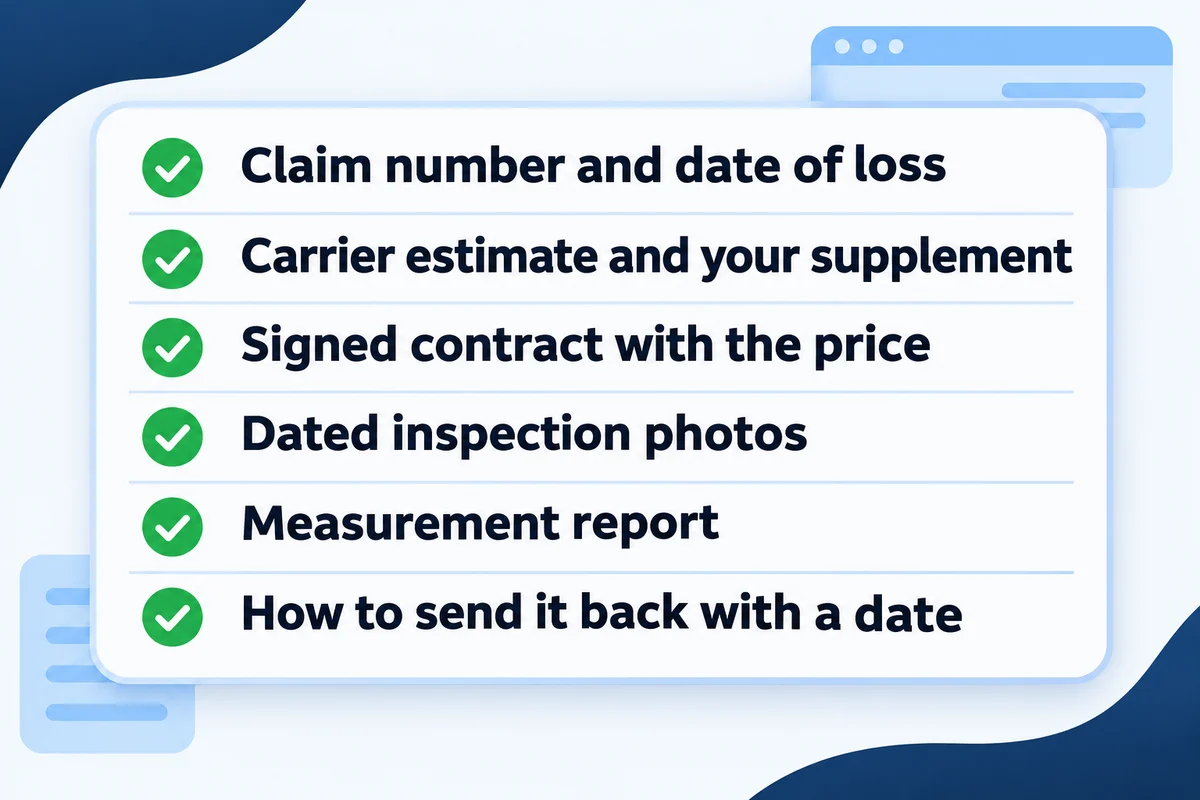
When a homeowner calls to say "the insurance sent me a form", the office should be able to send all of this the same day:
- The claim number and the date of loss, written exactly as the carrier has them. A form with a different date than the carrier's file starts a back-and-forth you do not need.
- The carrier's latest estimate, plus your own estimate or any supplement you sent, each with its date.
- A copy of the signed contract, so the homeowner can see the price they agreed with you.
- Your inspection photos of the damage, the slopes and the soft metals, with their dates and in the order you shot them.
- The measurement report, in case the form or the carrier asks for plans and specifications.
- A short note on how to send it back: through the carrier's portal, by email with a reply, or by certified mail, so there is a dated record. In Illinois that date is the one from the section above.
Then write the date the homeowner says they sent it on the claim, and ask for a copy of the signed form. If the mortgage company is named on the check, keep it in mind: California's policy even says that if the insured does not send the proof, the mortgagee "shall render proof of loss" within 60 days after notice. The money on a roof claim rarely moves without the lender, and our loss draft tracking page covers that side.
Where these dates live in CRM For Claims
Every proof of loss repeats two facts from the claim: the claim number and the date of loss. If someone saves the claim details in CRM For Claims without a claim number, the save is refused with Claim Number, Claim Status and Summary of Loss named as required. A Date of Loss cannot be in the future, so a mistyped year is caught before it reaches any form. Dates of loss are kept as their own list in CRM For Claims, with a screen for adding a new one. Our storm and date of loss tracking page shows how one storm date serves every roof it hit.
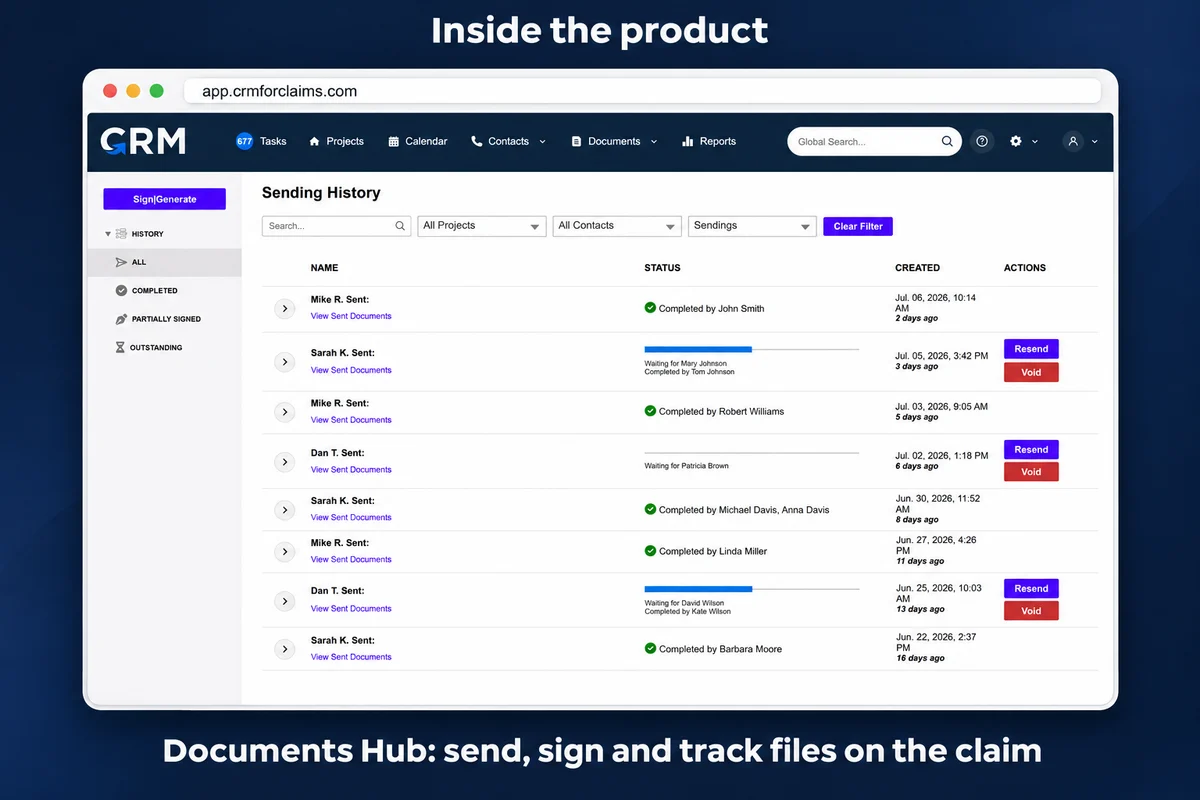
When the office sends paperwork from the Documents Hub, the Claim Number field automatically fills in the project's assigned claim number, so the cover letter and the forms you send carry the same number the carrier uses. More on how papers are kept with the claim is on the document management page.
If you want to see one of your own roof claims laid out this way, with the dates a proof of loss needs in one place, book a short walkthrough. Bring a claim that has a proof of loss on it and I will show you where each piece sits.