
When hail or wind damages a detached garage roof, the homeowners policy usually pays for it from "other structures" coverage, often called Coverage B, not from the part that pays for the house. That part has its own limit, most often 10% of the dwelling limit, and that one amount is shared by the garage, the shed, the fence and every other detached structure on the lot. The same storm usually means one deductible. For the roofer, the detached garage roof is a second scope on the same insurance claim, and it has to stay separate in the estimate, the contract and the invoice.
I build CRM For Claims, software for roofing and restoration companies that run insurance claims. The garage is where a clean roof claim gets messy: the adjuster writes it in a different section, the homeowner thinks it is "part of the roof", and the office invoices one number for two buildings that were paid from two different pots.
Is the garage paid as part of the house or as another structure?
It depends on whether it is attached. The Texas Department of Insurance puts the usual rule in one line on its page about which structures a home policy covers:
Most policies define "other structures" as structures not attached to your house.Texas Department of Insurance. The same page lists a detached garage, a storage shed, a pool or guest house, an outdoor kitchen, barns and a chicken coop as examples.
On site, sort every roof you measure before you leave the property. Most fall into one of the first two columns. Write down why, with a photo that shows how the building meets the house.
Paid as the house
- A garage under the same roofline as the house
- A garage that shares a wall with the house
- A porch or addition built onto the house
Paid as other structures
- A garage across the driveway with open space between
- A storage shed or a pole barn
- A pool house or a gazebo with shingles
- The fence the hail also hit
Ask the adjuster in writing
- A covered breezeway joining garage and house
- A garage the homeowner uses to run a business
- A building the homeowner rents to someone
The third column matters most. The Texas page tells homeowners to ask their insurer whether a structure used for a business needs its own policy. If the adjuster's answer changes which limit pays, you want it in an email on the claim before you price the job.
How the 10% limit is shared, worked on one property
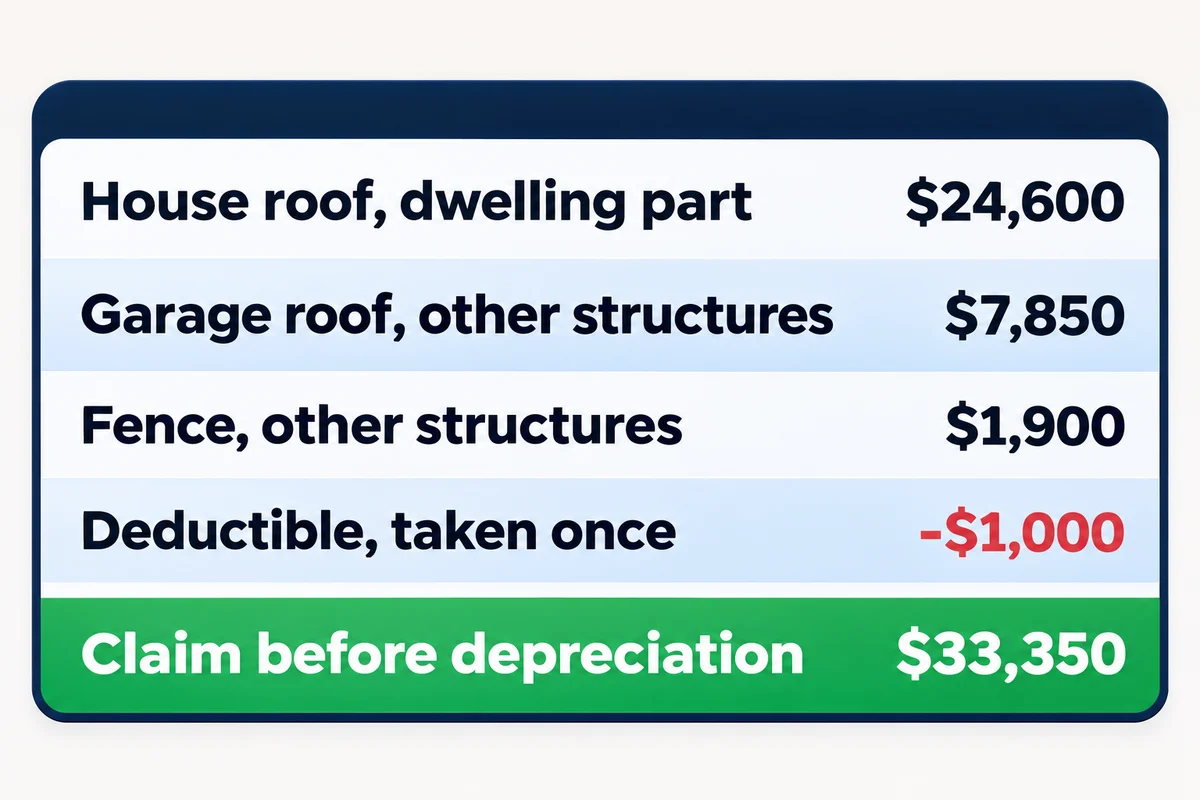
The limit is one pool for every detached structure together, not 10% per building. Here is one example property after a hailstorm. The numbers are made up to keep the math simple; the way they add up is the point.
Other structures limit: $32,000 (10% of a $320,000 dwelling limit)
Same storm, same claim. The house roof, $24,600, is paid from the dwelling part and does not touch this pool.
Two lines in that example are easy to miss. The fence: Texas says policies "usually pay actual cash value for fences", meaning age is subtracted, so its line will not grow when the work is done. And the garage roof: if the policy pays replacement cost on other structures, part of that $7,850 may be held back as depreciation until the work is finished, the same way the house roof is. I went through getting that money released in recovering depreciation after the work is done.
When the garage roof costs more than the limit
Then the policy pays up to the limit and the homeowner pays the rest. This happens more than people expect with a large detached shop, a barn with a metal roof, or a four-car garage on a house with a modest dwelling limit. A second example:
40 x 60 detached shop, metal roof, after hail
| Dwelling limit | $250,000 |
| Other structures limit, 10% | $25,000 |
| Shop roof, as written | $27,400 |
| Fence, as written | $1,600 |
| Total for other structures | $29,000 |
| Above the limit, owed by the homeowner | $4,000 |
That $4,000 comes on top of the deductible. Find it before the contract is signed, not at the final invoice. Ask the homeowner for the declarations page (the summary page of the policy with every limit on it), read the other structures line, and put the gap in writing. A homeowner who learns about it at the end tends to blame the roofer, even though the number was in their policy all along.
Some policies let the owner raise this limit, but only for the future: a change made after the storm will not pay for this one. If the declarations page also shows ordinance or law coverage, code items on the garage are a separate question, covered in who pays code items on a roof claim.
One storm, how many deductibles?
Usually one. Most homeowners policies take the deductible once per loss, and one hailstorm that hits the house and the garage on the same day is one loss. Read the deductible section of the policy to be sure, because the size of that deductible can surprise you.
| What the declarations page shows | Deductible on the example storm |
|---|---|
| A flat all-perils deductible of $1,000 | $1,000, once, for the house, garage and fence together |
| A separate wind and hail deductible of 2% of the dwelling limit | 2% of $320,000, which is $6,400, once for the same three |
The second row changes the homeowner's math more than the garage does. And whatever the deductible is, the homeowner pays it: what a roofer may and may not say or do about it is in the deductible rules for contractors.
Keeping two roofs apart in your paperwork
The carrier pays the garage from a different part of the policy, and the claim often comes as one check. Your file should still show two roofs from start to finish:
- Check that the adjuster wrote the garage in its own section of the estimate, not mixed into the house roof. If a building is missing, ask for a reinspection before tear-off.
- Name the building on every photo: "garage, rear slope". A folder of 140 hail photos with no building named helps nobody six weeks later.
- Give the garage roof its own line and price in the contract, so the homeowner sees what the limit pays and what they pay.
- Build the invoice in the carrier's sections, line for line. A single total for two buildings is hard to match against the estimate.
- If depreciation is held on both roofs, the papers that release it have to name both buildings and both totals.
Where CRM For Claims keeps these numbers
Everything above starts with the policy, so that is where the claim screen starts too. In CRM For Claims the Deductible Amount is a required field on the claim, and a separate Hail/ Wind Deductible Amount field sits next to it for policies that have one. The claim also asks whether the policy is a Replacement Cost Value policy, which tells the office whether depreciation will come back on the garage and the house. If the policy has code coverage, its Ordinance and Law limit has its own field on the same screen.

The claim number ties both roofs to one file: if someone saves the claim details without it, the save is refused with Claim Number named as a required field. What the money side looks like as payments come in is on the recoverable depreciation tracking page.
If you have a claim with a garage, a shed or a shop on it right now, book a short walkthrough and bring the declarations page. I will show you where each limit and each roof sits in one file.