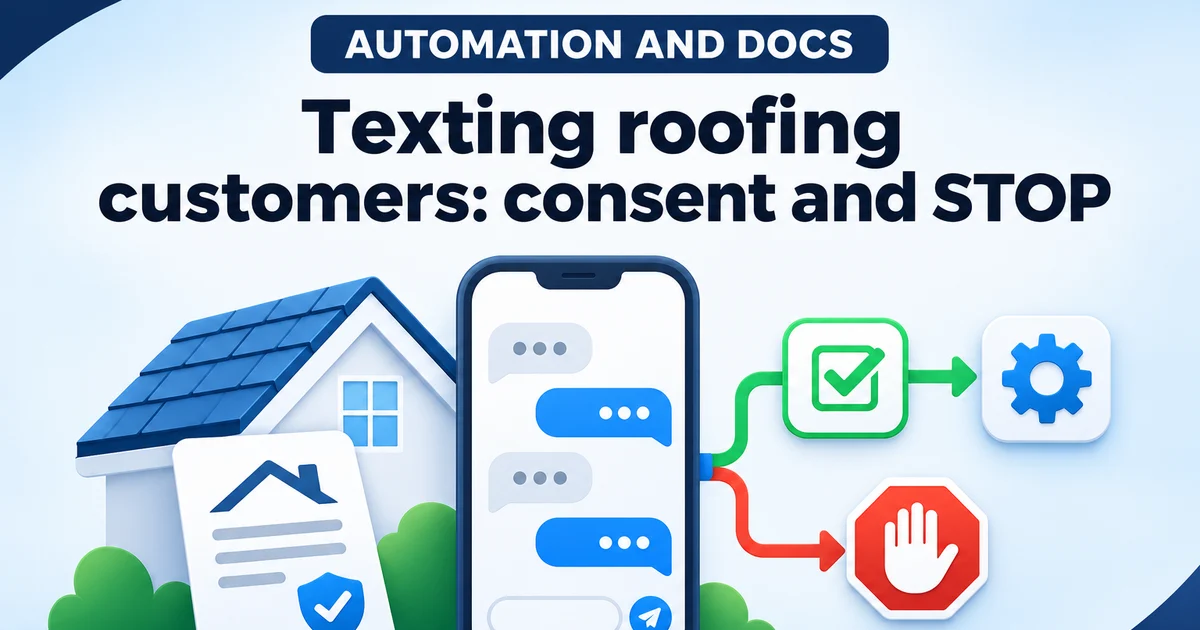
Texting roofing customers about their own job is generally allowed once they have given you their number for that job: inspection times, the crew arriving, a document to sign, a payment link. Marketing texts, such as a storm offer sent to last year's customers, need the person's prior express written consent. Whichever kind it is, a reply of stop, quit, end, revoke, opt out, cancel or unsubscribe has to be honored, and the federal rule gives you no more than ten business days to do it. And before the first text goes out, the number you send from should be registered for business texting through your texting provider.
I build CRM For Claims, software for roofing and restoration companies that run insurance claims, and the CRM sends texts straight from the claim. So I had to decide, line by line, what a STOP reply switches off and what it does not. This is the office version of those rules, written for the person who reads the replies. It is not legal advice: have your lawyer read your consent wording before anything goes to a list.
Which texts on a roof claim need which consent?
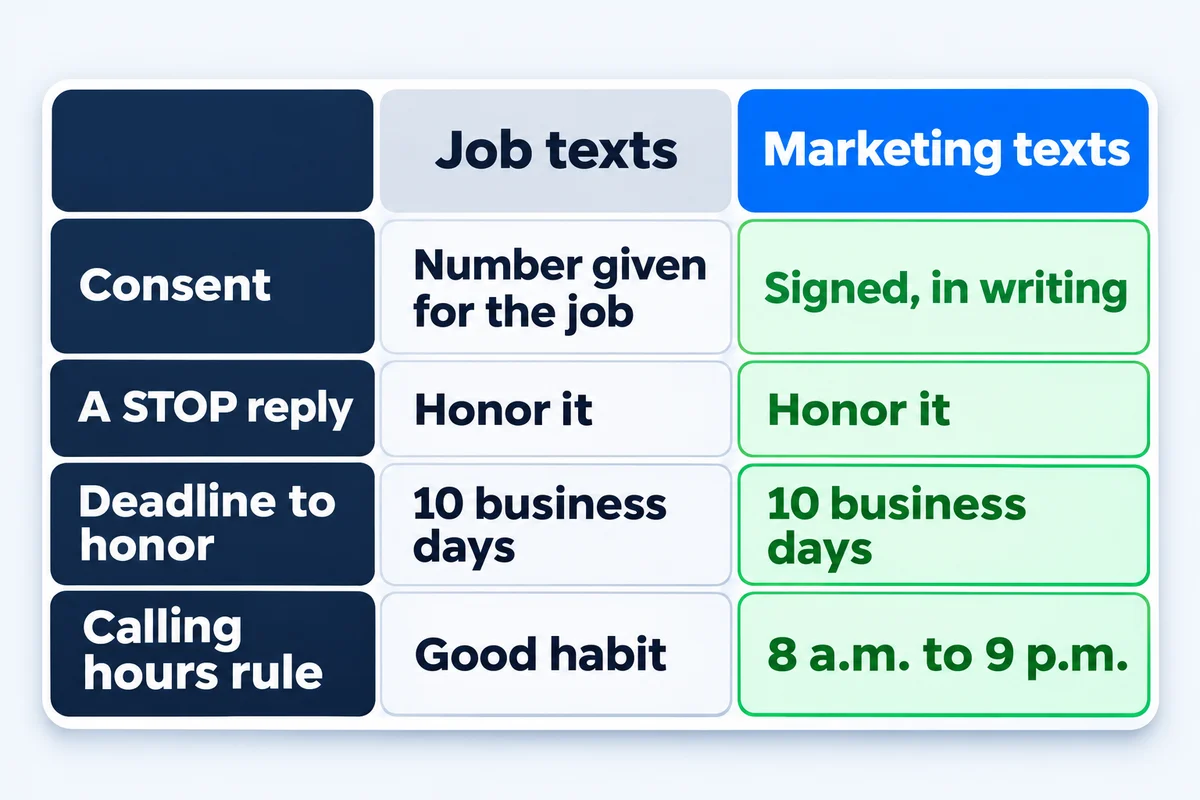
Job texts need ordinary consent, marketing texts need written consent. The FCC rule in 47 CFR 64.1200 draws the line by what the text is for, not by the tool that sends it. A text about this customer's claim is information. A text that offers them something new is telemarketing, and for that the rule asks for an agreement in writing, signed by the person, that covers the number you text. Sort every text your office sends before you argue about any of them:
| Text on the claim | What it is | Consent you need |
|---|---|---|
| Inspection time, reschedule, reminder | Job update | The number they gave you for this job |
| Crew arriving today, dumpster tomorrow | Job update | The number they gave you for this job |
| Contract or certificate of completion to sign | Job paperwork | The number they gave you for this job |
| Invoice or payment link | Job paperwork | The number they gave you for this job |
| Review request after the roof is done | Disputed | Ask your lawyer; written consent is the safe side |
| Storm offer to past customers | Marketing | Prior express written consent |
| A blast to numbers collected at the door | Marketing | Prior express written consent, signed before the first text |
The review request row is the one people disagree on. Some vendor guides call it a job text. It does not help the claim and it promotes the company, so I put it first in line to switch off when a customer says stop. The last row comes up every hail season. A clipboard of numbers from a door-knocking weekend is not consent to text them a promotion; I wrote about clearing the door itself in the storm canvassing rules for roofers.
Calling hours are a separate rule. The same section bans telephone solicitation of a home before 8 a.m. or after 9 p.m., local time where the person is. It is written for marketing, but a crew-arrival text at 6:40 a.m. still wakes someone up, so most offices keep job texts inside the same hours.
Which replies count as STOP?
Any reply that clearly means "no more texts" counts, whatever the words. The rule names seven words that always count as a reply: stop, quit, end, revoke, opt out, cancel and unsubscribe. Past those, a person may revoke "by using any reasonable method to clearly express a desire not to receive further calls or text messages". Homeowners do not type keywords. They type sentences, usually from a truck or a kitchen. Real replies from a roof claim read like this:
- STOP opt-out
- One of the seven words. Nothing to think about.
- Please stop texting me opt-out
- The please in front changes nothing. The meaning is clear.
- End opt-out
- Maybe they meant the end of the job. Sent alone, it is still one of the seven words, so treat it as one and ask by phone if you think it was a slip.
- Cancel the inspection, I work Thursday reply
- They want a different time, not silence. Offer one.
- Can you stop by after 5? reply
- The word stop is in there, and it asks for the opposite of an opt-out.
- Wrong number opt-out
- Not a keyword, but the person who has this phone never agreed to anything. Stop texting the number and fix the contact on the claim.
- Just call me from now on opt-out
- A plain wish for no more texts. Switch the claim to calls and write that down where the next person will see it.
The last two are why a keyword filter is not the whole job. Somebody in the office reads every reply that is not a keyword, the same day it arrives.
The opt-out rules changed in 2024 and again in October 2026
Older guides you find were written for one version of the rule or the other. The order of events, with what each step means for a roofing office:
- In 2024 the FCC wrote the revocation rules. Any reasonable way of saying stop counts, the seven words count as a reply, the request is honored "within a reasonable time not to exceed ten business days", and one short confirmation text is allowed.
- One piece of the 2024 rule, called revoke all, would have made a STOP to one kind of text end every call and text to that person. It was put on hold by waiver, most recently until January 31, 2027.
- On October 1, 2026 the FCC released a new order, FCC 26-67. An opt-out from informational texts can be limited to that kind of text, while a marketing opt-out stays all or nothing. A business may name its own opt-out method if it is shown clearly in every text, and it still has to honor the seven words. A business that names none stays under the any reasonable means standard.
- Still open: the new rules start 30 days after they are published in the Federal Register, and the FCC asked whether to cut the ten business days to seven.
The 2026 steps come from the Nixon Peabody alert of October 7, 2026. Check that the order is in force before you change the opt-out line in your texts.
After a STOP: five minutes and ten business days
You get one text back, and the clock starts. The rule allows a single confirmation, and a short one:
If the confirmation text is sent within five minutes of receipt, it will be presumed47 CFR 64.1200(a)(12): presumed to be covered by the consent the person gave earlier. The confirmation must be the only message sent after the request, and it may ask whether the person meant all messages. A later one has to show the delay was reasonable.
Then the office routine, the same for every claim:
- Send at most one confirmation, inside five minutes. No offer in it and no "are you sure". Asking whether they meant job updates or everything is fine.
- Mark the number on the claim the same day, with the date and the words they sent.
- Stop that kind of text everywhere it comes from: the CRM, the review tool, the marketing tool and the rep who texts from their own phone. The rep is the one who keeps texting, because nobody told them.
- Move the job to calls or email and say so on the claim, so nobody sends "one quick reminder" next week.
- Keep the STOP text itself. How long a text record should be kept is in text messages as evidence on a claim.
- If they later text START or ask you to text them again, record that too, with the date.
Register the number before the first text
Business texts from an ordinary ten-digit number go through The Campaign Registry. Its about page calls it the hub where messaging providers register their customers' brands "along with the campaigns linked to those brands". A roofing company cannot register itself there; the provider you text through does it for you, declaring who sends and what kind of texts. Two things to get right on that form: describe what you really send, job updates first and marketing only if you send marketing, and use the company name homeowners see on the contract and the truck.
What CRM For Claims does with a STOP reply
When a customer replies to a text from CRM For Claims, the reply is filed on the claim it answers. The CRM reads stop, quit, end, revoke, opt out, cancel and unsubscribe as opt-out words. Replies that only contain the word, such as a request to stop by after five or to cancel the inspection, stay ordinary replies.
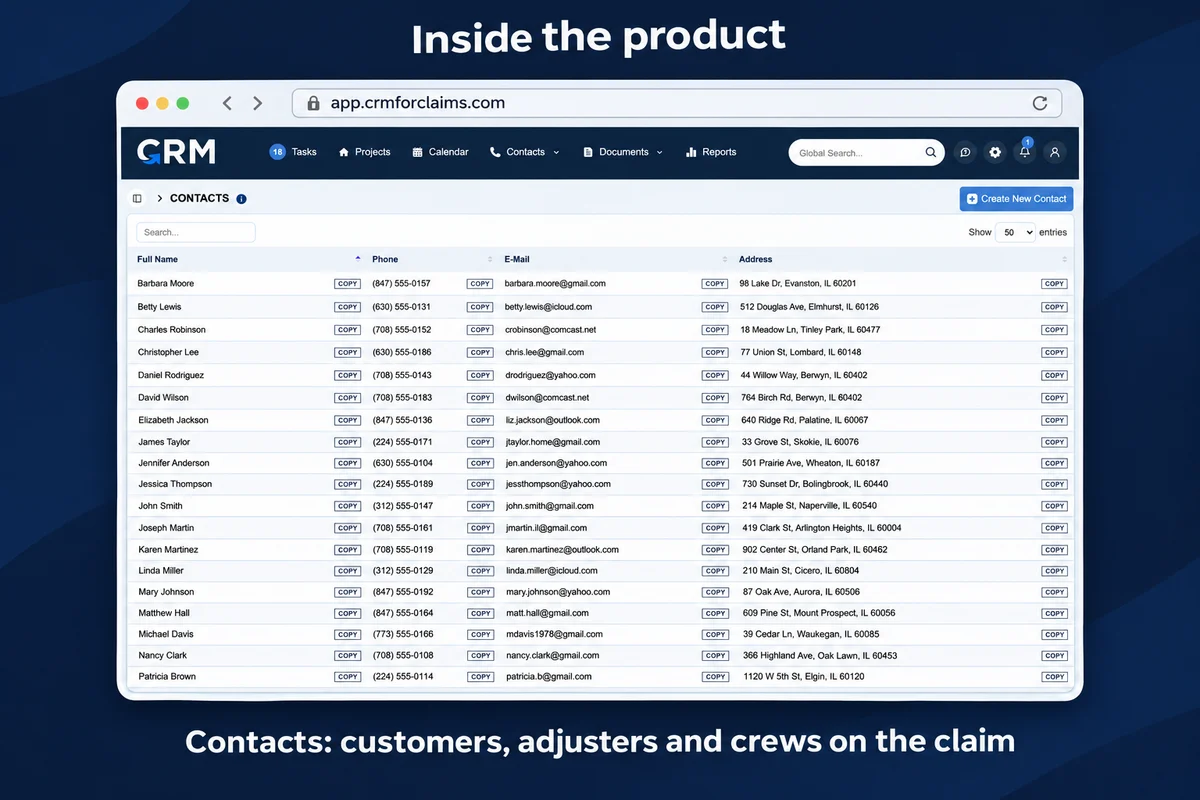
After a STOP, the CRM stops sending that customer its optional texts: automatic project updates and review requests. Documents to sign, invoices, receipts and payment notices still go. When an optional text is skipped for a number that opted out, the skip is logged. A START reply turns the optional texts back on. The texts the CRM sends on its own come from stage automations. Why a message belongs on the claim rather than in somebody's phone is in SMS and email that log themselves on the claim.
If your office texts homeowners from the CRM, from personal phones and from a marketing tool at the same time, that is three places a STOP has to reach. Book a short walkthrough and I will show you where a reply and an opt-out sit on one claim.