Short answer: Keep any text that records a decision, a permission, a promise or a complaint, and keep it as a record with the number and timestamp intact rather than a screenshot. How long is set by three clocks running at once: a preservation duty, your state limits on defect claims, and consent records for marketing texts.
I build CRM For Claims, and the question of text messages as evidence never arrives as a question about evidence. It arrives as a sentence like “she says we never told her the deductible was hers to pay, and Dave has the texts but Dave left in April.” Nobody was careless. The thread existed, it said exactly what you needed it to say, and it lived on a handset that is no longer in the building.
This is not the same problem as messages being visible to the team while a claim is running — I have written about SMS and email that log themselves on the claim and that argument is operational. This one is evidentiary. It is about what survives, in what form, once somebody who was never on the job asks to see it.
Are text messages actually evidence?
Yes, and they have been for a long time. A text message is electronically stored information, discoverable in civil litigation like any other business record under Federal Rule of Civil Procedure 34. The real question is never whether a text counts. It is whether you can produce it, a year later, in a form somebody else will accept.
That is where most contractor text records fall apart. A single message bubble cropped out of a thread is a picture of a claim about a conversation. It is not worthless, but it is the weakest version of the thing, and it invites the obvious reply: what did the next message say? What a defensible record looks like is duller — the whole thread rather than the useful bubble, the counterparty’s actual phone number rather than a contact name (a contact name is a label you typed and can retype), the timestamps, and a location for the file that does not depend on one person’s phone still existing.
There is also a duty attached to it, and it starts earlier than people expect. Rule 37(e) applies when electronically stored information “should have been preserved in the anticipation or conduct of litigation” and is lost because a party failed to take reasonable steps to preserve it. Where that loss prejudices the other side, a court may order measures to cure the prejudice; where it finds the party acted “with the intent to deprive another party of the information’s use in the litigation,” it can instruct a jury to presume the lost information was unfavourable, or dismiss the case outright.
Read that trigger again: anticipation of litigation, not the arrival of a lawyer’s letter. The afternoon a homeowner says they are going to talk to an attorney is the afternoon the clock starts, which is a good reason to write that sentence down on the claim when it happens.
Which text messages actually matter on a claim?
Not all of them, and pretending otherwise is how a retention policy dies in week two. The ones worth keeping record a decision, a permission, a promise or a complaint — anything a reasonable person could later remember differently. Sort by whether a sentence could be disputed, not by who sent it or how important they felt.
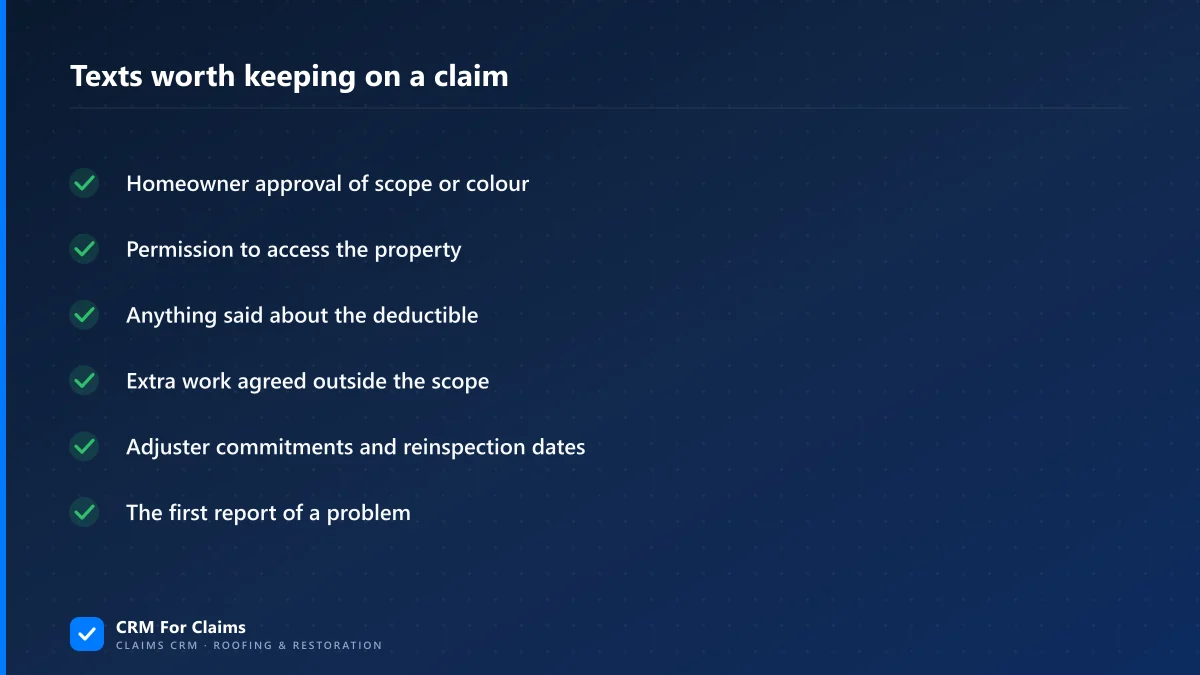
| Message | What it actually proves | Keep it? |
|---|---|---|
| Homeowner picks a colour or approves a scope choice | What they chose, and on what date | Yes |
| Gate code, alarm code, go-ahead for Tuesday | You were authorised to be on the property | Yes |
| Anything said about the deductible | What was represented about who pays it | Yes — this is the one |
| Extra work agreed in the driveway | An agreement sitting outside the signed scope | Yes, then paper it properly |
| Adjuster naming a reinspection date or a line item | What the carrier said before the position moved | Yes |
| First mention of a leak, a stain, a complaint | The date you first knew there was a problem | Yes |
| Running twenty minutes late | Nothing anybody will ever litigate | No |
The deductible row is the one I would protect first, because it is the single sentence most likely to be recalled generously by both sides and it sits on top of rules that vary by state. What can and cannot be said about it is a whole subject on its own — see what you can and cannot do about a deductible — but the record-keeping point is narrower. If a salesperson texted something loose two years ago, you want to know that before a regulator or an attorney tells you.
The last row matters for a different reason. The date a homeowner first reports a problem is frequently the date a clock starts, and it is almost always in a text rather than a file. Without it, triaging warranty callbacks after a claim closes becomes an argument rather than a classification.
How long do you have to keep text messages?
There is no single number, and anyone who offers you one confidently is guessing. Three separate clocks run at the same time and the longest one governs: a preservation duty triggered by anticipated litigation, your state’s limits on construction defect actions, and — a completely separate regime — consent records for marketing texts.
| Clock | Starts when | Runs how long |
|---|---|---|
| Preservation duty (litigation hold) | You reasonably anticipate a dispute | Until it is resolved — it overrides every other rule here |
| Construction defect exposure | Discovery of the defect, and separately completion | Years, and genuinely different in every state |
| Marketing consent and opt-out records | Consent given, or a do-not-call request made | A do-not-call request must be honoured for five years |
| Ordinary business records | The job closes | Your accountant’s answer, not a software vendor’s |
I am not a lawyer and this is not legal advice. The defect clock in particular is state law, it usually comes as a pair — one period running from when a problem is discovered and a longer outer limit running from completion regardless of discovery — and it is worth asking an attorney in your state once and writing the answer on a card rather than trusting any blog that publishes state-by-state numbers.
The rule I would actually run is simpler. Keep claim-related texts as long as you keep the claim file, and keep that longer than you think you need to. Storage is the cheapest thing in this business. Reconstructing a conversation from memory in front of somebody who has the other half of it is the most expensive.
What does keeping a text message actually mean?
Not a screenshot sitting in the camera roll of the phone that took it. Keeping means the message exists somewhere the company controls, attached to the claim rather than to a person, with the counterparty’s number and the timestamp intact, and that it survives a lost handset, a changed number and an employee leaving.
There are three levels of this and most companies are on the first without having chosen it.
- On a personal phone — the record belongs to a person, not to the business. It walks out with them, and asking for it back after a bad exit is a conversation with no leverage in it. This is the same failure that makes reassigning a claim when someone leaves so much harder than it looks.
- Screenshots dropped into a job folder — better than nothing, and a real improvement over hoping. It crops context, the contact name is editable, and the image carries no metadata worth anything. Fine as a habit for a one-person shop; it does not scale to a second person.
- Sent and received through a system that files it on the claim — the thread exists independently of any handset, with the number and the time attached, and a new owner inherits it when the claim is reassigned.
One assumption worth killing early: your mobile carrier is not your backup. Carriers keep billing records of which numbers exchanged messages far longer than they keep the content of those messages, and content retention, where it exists at all, is short. Treat the content as yours to keep.
Do you need permission to text a customer?
For ordinary job communication with a homeowner who gave you their number for that job, you are a long way from what the rules target. What they bite on is marketing. A telemarketing call or text needs prior express written consent, and that phrase is a defined legal term rather than a description of a nod at the door.
Under the FCC’s rules at 47 CFR 64.1200, paragraph (a)(2) requires “prior express written consent” for those messages, and paragraph (f)(9) defines it as “an agreement, in writing, bearing the signature of the person called that clearly authorizes the seller to deliver… advertisements or telemarketing messages.” The rule is written about calls; it has long been applied to text messages. The same section requires that a do-not-call request be recorded when it is made, honoured within a reasonable time not exceeding ten business days, and honoured for five years.
Two things follow for record-keeping, and the second is the one that gets missed. The consent is a record you have to be able to produce. So is the opt-out — and because the exposure sits on the message you sent after somebody said stop, the STOP is the more important of the two to file properly. The federal catch-all limitation period is four years for statutes enacted after 1990 (28 U.S.C. § 1658), and the TCPA is a 1991 statute, so consent and opt-out records that only live for a season are the wrong length.
Where this stops being theoretical is storm canvassing. A list of numbers collected at the door plus a mass text about a hailstorm is a marketing campaign whatever it is called internally. Get the written consent at the door and keep it with the contact, or do not send the message. How you comply is a question for your own counsel; the point here is that consent is a record, and records need a home.
What if a text is the only record of a decision?
Then you confirm it somewhere else the same day. A text is strong evidence that something was said and weak evidence that both people understood it the same way, which is a different problem entirely. The answer is not to ban texting, because that never survives contact with a Saturday. It is to promote anything consequential into the document that governs it.
Three habits do most of the work:
- Promote it. Extra work agreed by text becomes a signed change order the same day, because a text agreeing to a price is not the document that gets paid on — the distinction between those and carrier supplements is the whole of change orders versus supplements on an insurance job.
- Confirm it back. “Confirming what we agreed: architectural shingle in weathered wood, starting the 14th, extra $840 for the porch roof. Reply yes if that is right.” A summary the other party had the chance to correct is worth more than a message they never answered.
- Never tidy a thread. Deleting messages once a dispute is reasonably anticipated is precisely the conduct Rule 37(e) is written about, and intent is the line between a court curing the prejudice and a jury being told to assume the worst about what you deleted.
Where does this belong in software?
In four dull requirements, none of which needs our product specifically. If your current tools already do these, you do not have a problem worth spending money on, and you can compare the rest of the shape on our CRM comparison page before deciding anything.
- Messages sent and received from the claim record, so the thread has an owner that is not a handset. This is what our claim pipeline and messaging features exist to do.
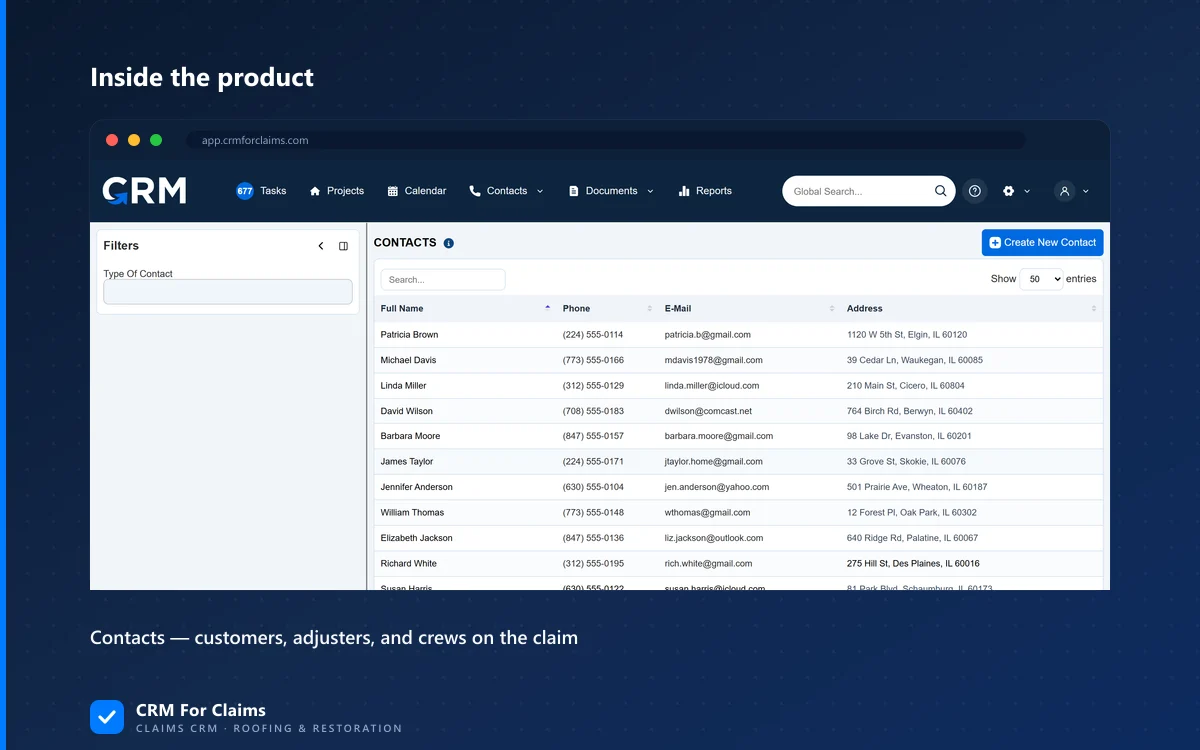
- The counterparty as a real contact with a real number — homeowner, adjuster, carrier, crew — so renaming somebody does not orphan the history.
- Deactivate people, never delete them. The audit trail has to keep naming who sent what, including people who left two years ago.
- An export you can actually produce. “It is in our CRM” is not a deliverable. Somebody will eventually ask for a file, and finding out then that there is no way to get one is the wrong moment.
The honest limits, stated plainly: CRM For Claims logs SMS and email against the claim and keeps them with the record. It does not decide your retention policy, apply a legal hold, or make a marketing text compliant. It is not an e-discovery platform, and in active litigation your attorney’s preservation instructions outrank every default in any software you own, including ours.
And the carve-out, because it is real. If you run a dozen claims a year and you are the only person who texts anybody, you do not need a system for this. You need one habit — the same-day screenshot into the job folder, with the phone number visible in the frame, not just the contact name. The threshold is not job volume. It is the first time somebody other than the person who sent the text needs to read it, which is usually the first hire. If you want to see how the messages, contacts and documents actually sit on a claim in ours, book a live walkthrough and bring your worst open file.