
When a storm damages a roof that already has two layers of shingles, the building code will not let you put a third layer on top, so replacing the damaged roof means tearing both layers off down to the deck. On an insurance claim the carrier usually pays for that second layer removal too, either as part of the cost to replace the roof or under the policy's ordinance or law coverage, because the code is what forces it. The big exception is a repair: if the carrier only owes a few shingles, the lower layer never gets touched and nobody pays to strip it.
I build CRM For Claims, software for roofing and restoration companies that run insurance work, and two-layer roofs come up more often than people expect on older houses. The trouble is timing. The layer count decides the scope, but once the crew starts the tear-off, the evidence is in a dumpster. This post covers what the code says, how the pay question branches, the one court case worth knowing about, and what to photograph before anything comes off.
What the building code says about a second layer
The residential and commercial model codes put the line in the same place. A new roof may go over an old one only when the old one is a sound base, and never once the roof already carries two coverings. NRCA's technical lead summarized the trigger in Reroofing by the book, written for Professional Roofing:
A re-cover is ruled out, and the old roof must come off, once a roof has "two or more layers of any type of roof system."Mark S. Graham, NRCA, Professional Roofing, February 2019, on IBC 2018 Section 1511 (IRC Section R908 carries matching requirements)
When removal is required, it goes all the way down to the deck. The one thing allowed to stay is an ice barrier membrane that is adhered to the deck, which can be covered with a fresh layer of the same. Each trigger plays out differently on a claim file:
- Two or more existing layers
- The trigger you will see most. Three-tab shingles from the 1990s with architectural shingles nailed over them in the 2000s is a common house on a storm list. Any replacement on that roof is a full tear-off, whatever the carrier's estimate assumed.
- A water-soaked or deteriorated roof
- Even a single layer has to come off if it cannot hold the next one. This matters for a claim because the carrier may call the same rot wear and tear. Photograph it as a condition of the base, and keep the storm damage evidence separate.
- Slate, clay, concrete or asbestos-cement tile underneath
- Rare under shingles, but when it is there it changes the job completely. Asbestos-cement brings its own removal rules, so stop and call before anyone pulls a piece.
Your town adopts a code edition and may amend it, so the permit office's reroof handout is the version that binds the job. Some local amendments are stricter than the model code, not looser.
Who pays to tear off the second layer?
In most replacement claims the carrier pays it, because there is no legal way to replace the damaged top layer without stripping the one beneath. What changes is which part of the policy the money comes from, and that decides whether there is a cap. Walk the claim through these four questions in order:
-
Is the carrier paying to replace the roof, or to repair it?
RepairThe lower layer stays where it is. Replacing a few slipped or bruised shingles on the top layer does not touch it, so there is nothing to pay. A repair on a two-layer roof is fiddly work, though, and worth noting on the file if the shingles will not seal. ReplaceGo to question 2. -
How many layers are actually on the roof?
OneNormal tear-off, priced on the estimate like any other roof. Two or moreThe code requires removing every layer. Check that the carrier's estimate prices the removal of each layer, not only the top one. If it prices one, that is the first line of your supplement, and the post on reading an insurance scope covers how to spot what is missing. -
Which coverage is the carrier using for the extra layer?
DwellingPaid as part of the cost to replace the damaged roof. No separate cap beyond the dwelling limit. Ordinance or lawPaid because the code requires it. That coverage has its own limit, usually a percentage of the dwelling limit, and some policies exclude it. Ask the adjuster in writing which one applies, then read the post on ordinance or law coverage on a roof claim before the homeowner signs anything. -
Is the lower layer doing the job of the deck?
NoPlywood or OSB is under both layers. Removal of the second layer is the whole question. YesOld wood shingles over spaced boards are what the top layer is nailed into. Once they come off, there is nothing to nail to, and new sheathing goes on. That is the variant carriers fight hardest, and it is the one a court has already answered.
The Oklahoma case where the bottom layer was the deck
The clearest ruling on this I have read is a 2007 decision from the Oklahoma Court of Civil Appeals, written up by Merlin Law Group on its property insurance coverage blog. The facts look like half the older houses in hail country.
The court's reasoning fits in one line: "a roof is a unified product comprised of all its component parts." A layer that serves as the deck is one of those parts. This is one appellate court in one state, and your state may never have ruled on it, but it is the argument to make, and the facts that won it are the facts you need on file. They are about what was under the top layer and what happens to it during removal, which is why the photos matter so much. If the deck itself is the problem, the post on rotted roof decking on a claim covers that separately.
Proving the layer count before the tear-off
The adjuster may walk the roof once, from the top, and write a one-layer estimate. Your proof has to exist before the crew starts, because after that there is only your word. These are the shots I would want on every multi-layer claim:
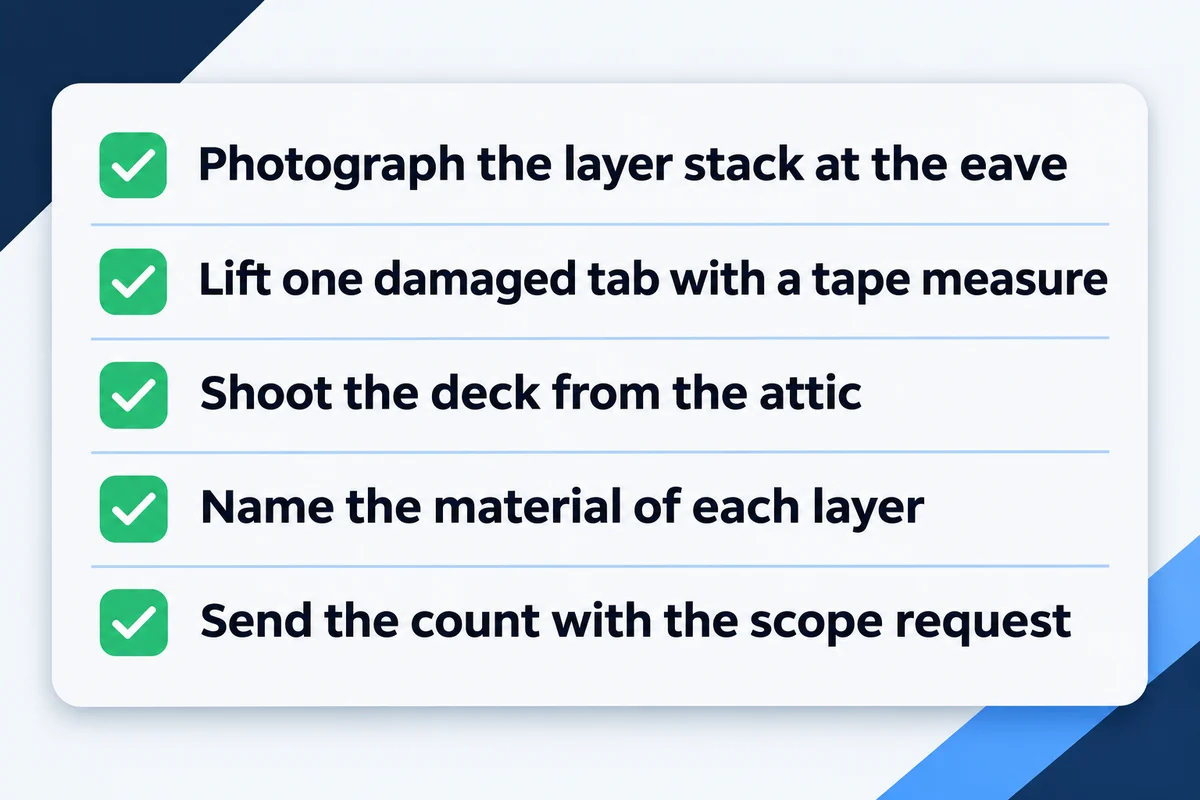
| Shot | Why the desk needs it |
|---|---|
| The eave or rake edge from the side, close up | Both layers show as a stack at the edge. It is the fastest proof and costs nothing to take. |
| One lifted tab with a tape measure against the stack | Shows the count and the thickness. Lift a tab you are already replacing, not a sound one. |
| The deck from the attic | Plywood, OSB or spaced boards decides whether question 4 above applies. |
| Any patched area where an older layer shows through | Tells you what the lower layer is made of, which the scope has to name. |
| The first strip of tear-off, before it goes in the dumpster | Shows the layers coming off together and anything stuck to the deck. Take it even if the carrier already agreed. |
Send the count in writing with the photos when you ask for the scope, not in the supplement after the job. A request that says "two layers, photos attached, code requires full removal" gets answered. A complaint after the roof is gone gets a "we have no record of that."
Check the endorsements for a multi-layer limit
Some homeowner policies carry an endorsement that limits what they pay on a roof with more than one layer, or that settles older roofs at actual cash value. Read the declarations page and the endorsements before you quote the homeowner what their share will be. If there is a cap, it is better to find it now than at the second check, and it may change whether the job makes sense at all.
Keeping the layer count on the claim
In CRM For Claims each project has a roof inspection checklist where the inspector picks the material of the top layer and then of a second, third and fourth layer underneath, so the count is part of the claim from the first visit. Wood shingles are one of the choices for the lower layers, which is the exact situation in the Oklahoma case. The same checklist has a Damaged Decking field where spaced boards are one of the choices, next to 10%, 25%, 50% and 100%.

Whoever writes the scope request then works from the inspector's count and not from memory. The rest of the claim workflow is on the features page, and plans with the per-user price are on pricing. If you have a two-layer roof on the board right now, book a live walkthrough and I will show you where its count and photos would live on a demo claim.