
Labor depreciation on a roof claim means the carrier takes depreciation off the labor in its estimate, the tear-off and the installation, and not only off the shingles and felt. Whether it may do that depends on two things: how your policy defines actual cash value, and which state the house is in. The quickest way to see it on a carrier estimate is the tear-off line. Tearing off a roof is pure labor, so any depreciation printed against it means the labor was depreciated.
I build CRM For Claims, software for roofing and restoration companies that run insurance work, and the first check on an older roof is where a lot of office calls start. The homeowner sees a number far below the estimate, the sales rep promised the job would be covered, and somebody has to explain where the money went. A good share of it is often depreciated labor. This post shows where to find it on the estimate, what the rules say in the states where courts and regulators have answered, and what it does to your cash flow.
Which lines on a roof estimate are labor
A carrier estimate prices most lines as one unit cost with material and labor folded together, so the split is not printed for you. You can still sort the lines. Here is an example replacement, priced at a round $21,600 so the arithmetic stays easy to follow. The numbers are mine for illustration, not a real claim.
| Part of the job | What it is | Example cost | Labor or material |
|---|---|---|---|
| Shingles, felt, starter, ridge cap, drip edge | What goes on the roof and wears out with it | $9,000 | Material |
| Installing the new roof | The crew's time to lay, cut and nail it | $8,100 | Labor |
| Tear-off of the old shingles | Removing what the storm damaged | $2,700 | Labor |
| Haul-off, dumpster, permit | Getting rid of the debris and filing with the town | $1,800 | Neither, a service |
On this roof labor is half the money. That is why the question matters so much more on roofing than on, say, a damaged appliance: a roof is mostly somebody's afternoon on a ladder. To check a real estimate, find the depreciation column and look at the tear-off line first. If it carries the same percentage as the shingle line, the carrier depreciated labor. If the tear-off shows zero and the shingles show 60%, it did not, at least on that line.
One roof, paid three ways
Say the example roof is 12 years into a 20-year life, so the carrier applies 60% depreciation, and the deductible is $1,000. The first check changes a lot depending on what the 60% is applied to. The bars below are drawn to scale against the full $21,600.
Everything depreciated, labor included
60% of $21,600 is $12,960 held back. $21,600 minus $12,960 minus the deductible.
Only materials depreciated
60% of the $9,000 in materials is $5,400 held back. Labor and haul-off are paid in full.
Installation depreciated, tear-off not
60% of materials and installation ($17,100) is $10,260 held back. Tear-off and haul-off are paid in full.
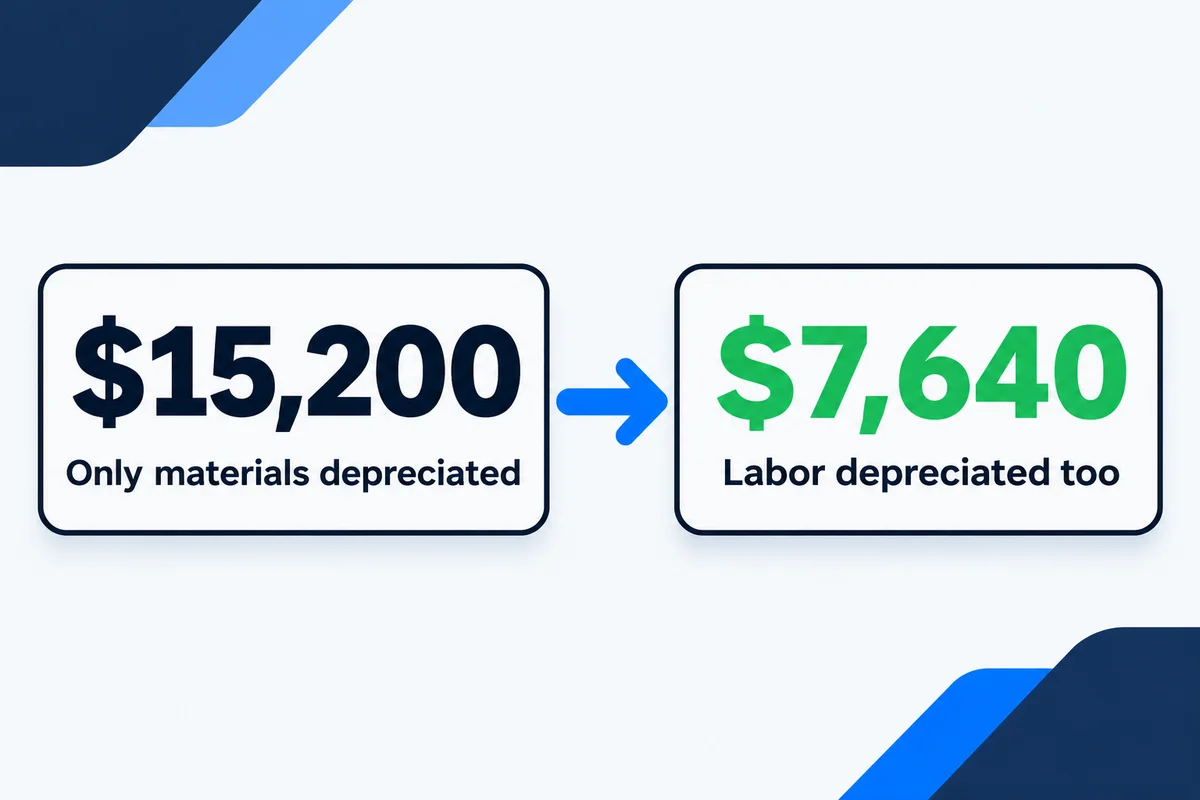
Same roof, same storm, same estimate, and the first check is either $7,640 or $15,200. The $7,560 between them is the labor depreciation. The third card is not a made-up middle ground. It is the rule an Oklahoma court actually landed on, which comes up again below.
Which states allow insurers to depreciate labor?
There is no national rule. A few states forbid it by regulation, several courts have said no unless the policy spells it out, and a few have said yes when the policy's definition is broad enough. Where nobody has ruled, the policy wording decides. These are the states where I could find and read the rule myself today:
California
Not allowed
The claims regulation, 10 CCR 2695.9, says labor to repair or replace covered property is not part of physical depreciation.
Vermont
Not allowed
The insurance regulator's Bulletin No. 184 treats depreciating labor as an unfair claim settlement practice, as IRMI's review of the question sets out.
Illinois
Not allowed unless the policy says so
The Illinois Supreme Court in Sproull v. State Farm, 2021 IL 126446: where the policy does not define actual cash value, labor may not be depreciated.
Missouri
Not allowed unless the policy says so
A Missouri appeals court in Franklin v. Lexington (2022), a roof claim, as reported by Merlin Law Group.
Arkansas
Allowed since August 1, 2017
Courts said no in 2013 and 2015. Act 279 of 2017 changed it, if the policy defines depreciation that way and the insurer explains the math in writing. See Bulletin 10-2017.
Oklahoma
Installation yes, tear-off no
In Branch v. Farmers (2002), the tear-off was treated as debris removal, which the policy did not depreciate. The case, explained.
North Carolina
Allowed under that policy wording
The state Supreme Court in Accardi v. Hartford (2020) read the policy's definition as covering labor, per Kilpatrick Townsend.
Maryland
A ban was proposed
The regulator proposed a bulletin in April 2025 and backed a bill in the 2026 session. Check its proposed bulletins page for the current status.
Washington's rule is the plainest of them. The core of it, in its own words:
"the expense of labor necessary to repair, rebuild, or replace covered property ... may not be subject to depreciation or betterment."Washington Administrative Code 284-20-010(4)
The same sentence carves out one thing, and carriers point to it: the factory labor already built into the price of a manufactured product, like a bundle of shingles. That part can be depreciated with the shingles. Your crew's time on the roof cannot. Rules like these change by statute, by bulletin and by the next court case, so treat the grid as where things stood when I wrote this, and look up your own state before you argue a file on it.
Read the policy before you argue the check
In every state that has not settled it by regulation, the courts go back to the words of the policy. Ask the homeowner for the full policy, declarations and endorsements, and read it in this order:
- Find the definition of actual cash value. It is usually in the definitions section or in the loss settlement condition. Some homeowner policies never define it, and that matters: in Illinois and Missouri a missing definition is what kept labor out of the depreciation.
- Look for the word labor inside that definition. An insurer that wants to depreciate it usually says so directly. One sample definition in IRMI's review lists "depreciation of the cost of labor" right next to deterioration and obsolescence. If you see wording like that, the argument in a state without a ban is mostly over.
- Check the endorsements for anything that puts the roof itself on actual cash value or on a payment schedule by age. On those roofs the depreciated part is not coming back, labor or not. The post on roof payment schedules on a hail claim walks through one carrier's filed schedule.
- Then compare the estimate to what you found. Depreciation on the tear-off line in a state that bars it, or under a policy that never mentions labor, is a specific and fixable error. Point at the line, cite the rule, and ask for a revised estimate in writing.
RCV or ACV: a wait or a loss
On a replacement cost policy the labor depreciation is usually not lost. It is held back and paid as recoverable depreciation once the roof is finished and the carrier has your final invoice and completion paperwork. For the roofer that makes it a cash flow problem: a bigger share of the job sits with the carrier until the end, so the deposit and the first draw cover less of your crew and material bill. How to get that release paid is in the post on recovering depreciation after the work is done.
On an actual cash value policy, or on a roof the endorsements value at actual cash value, the same depreciation is gone for good. In the example above that is the $7,560 gap between the first and second cards, and it becomes either the homeowner's bill or a reason the job does not get signed. So the policy type is the first thing the office should know about any claim, before anyone promises the homeowner what the roof will cost them.
On the claim screen in CRM For Claims there is a question, Is this a Replacement Cost Value Policy (RCV)?, so the office knows from the start which of the two cases it is in. The same screen keeps the deductible amount and a separate hail and wind deductible amount, which is where the first check starts shrinking before any depreciation is taken. When the checks arrive, each invoice gets a payment type, and Recoverable Depreciation (RC) and Non-recoverable Depreciation are separate types next to Actual Cash Value (ACV), so the labor depreciation you will get back and the part you will not are booked apart.
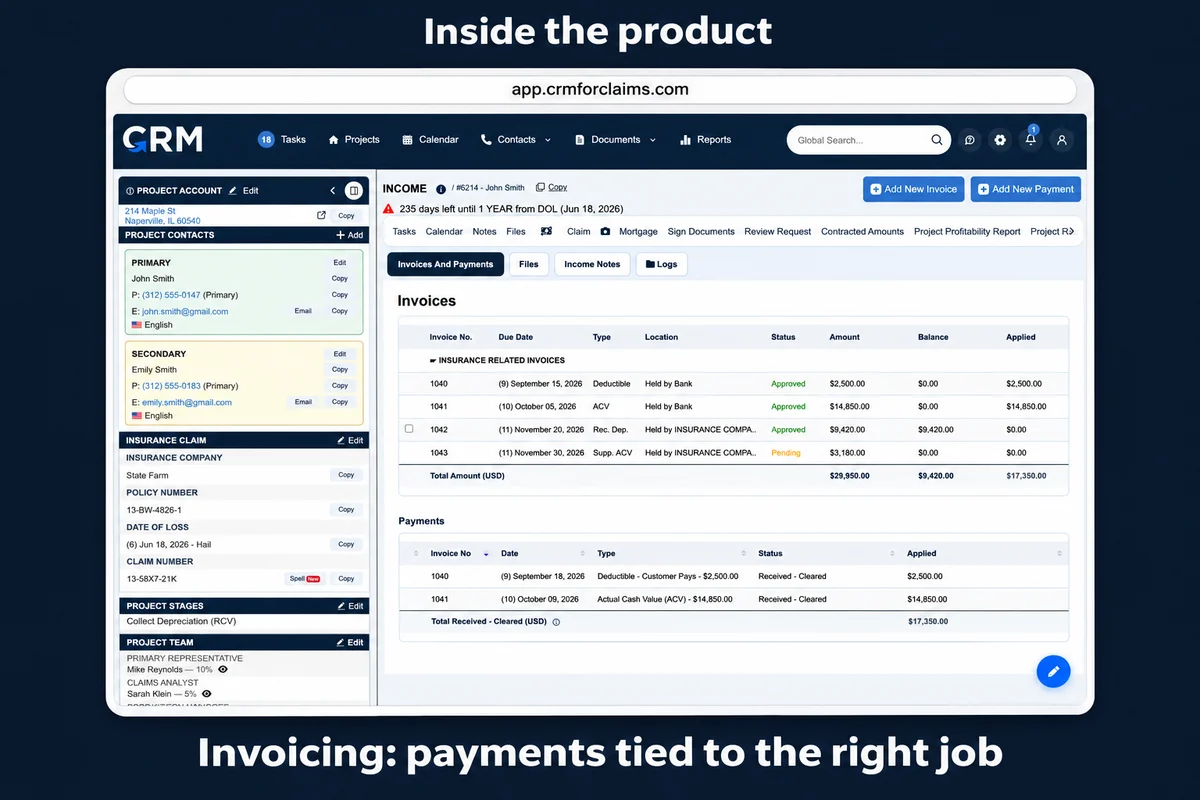
The way insurance checks become invoices is on the estimates and invoicing page, and the rest of the claim workflow is on the features page. Plans and the per-user price are on pricing. If you want to see an ACV check and its held-back depreciation booked against one demo claim, book a live walkthrough and bring a real estimate with the names taken off.