
Yes, in most states a roofer can add a credit card surcharge when a homeowner pays an insurance job by card, as long as the fee is told to them before they pay and is no bigger than what the card actually costs you. A few states ban it outright. On an insurance roof the surcharge has one more twist: the adjuster's estimate never pays for it, so whoever chooses the card pays the fee, and that is either the homeowner or you.
I build CRM For Claims, software for roofing and restoration companies that run insurance claims, and card fees come up every time an office turns on online payments. A roof claim is paid in three or four pieces, and every piece can be paid by check, by bank or by card. This post reads the laws I could check on official pages today, prices card fees on one real-shaped hail claim payment by payment, and gives you contract wording to take to your attorney.
Which states let a roofer add a card surcharge?
Most states allow it, and the ones that do not say so plainly in their statutes. I read the three below on their legislatures' own pages today. Each one shows a different kind of rule: a full ban, a ban that also covers debit cards, and a state that allows the surcharge but tells you how to show it. On top of state law, the card brands have their own rules, and Visa publishes one of them on its own site.
Banned for card payments
No seller in any sales transaction may impose a surcharge on a cardholder who elects to use a credit card in lieu of payment by cash, check or similar means.
A Massachusetts roofer can offer a lower price for cash or check, but cannot add a fee for the card.
M.G.L. chapter 140D, section 28ABanned, debit cards named too
A seller in a sales transaction may not impose a surcharge on a cardholder who elects to use a credit card or debit card.
Maine's rule is written into its consumer credit code and names both kinds of card in the same sentence.
Maine title 9-A, section 8-509Allowed, with the card price posted
clearly and conspicuously post the total price for using a credit card in such transaction, inclusive of surcharge
The surcharge may not exceed what the card company charges the business, and each violation can cost up to $500.
New York General Business Law section 518Tell your processor first
Merchants must notify their acquirer 30 days before they begin surcharging.
Your acquirer is the company that processes your cards. Ask them, in writing, for the highest surcharge your agreement allows and which cards it may be put on.
Visa, regulation and fees for businessesIf your state is not on this list, read its own statute before you print anything. Search your state's code for "surcharge" next to "credit card", and check the date on the page. A list of states on a vendor's blog, with no links, is not a source.
What card fees cost on one hail claim, payment by payment
On a claim of about $18,000, card fees come to roughly $500 if every payment goes on a card, and about $15 if the homeowner pays from a bank account. The difference is large because a roof claim moves big amounts, and a card fee grows with every dollar while a capped bank fee stops at $5.
Here is one composition roof after a hail storm, with round numbers so the math is easy to follow. The carrier's estimate is $18,400 replacement cost. The carrier holds back $4,200 of depreciation until the work is done, and the homeowner has a $1,000 deductible, so the first carrier check is $13,200. The roofer collects the job in three payments. For the card column I used an example rate of 2.9% plus 30 cents per payment; your processor statement has your real rate. The bank column uses Stripe's published ACH Direct Debit price of 0.8% capped at $5.
| Payment | Where the money comes from | Card cost (example rate) | Bank cost |
|---|---|---|---|
| 1. Materials delivered: $7,100 | The $1,000 deductible plus $6,100 of the first carrier check | $206.20 | $5.00 |
| 2. Roof finished: $7,100 | The rest of the first carrier check | $206.20 | $5.00 |
| 3. Depreciation released: $4,200 | The second carrier check, after the completion paperwork | $122.10 | $5.00 |
| Whole claim: $18,400 | Carrier $17,400, homeowner $1,000 | $534.50 | $15.00 |
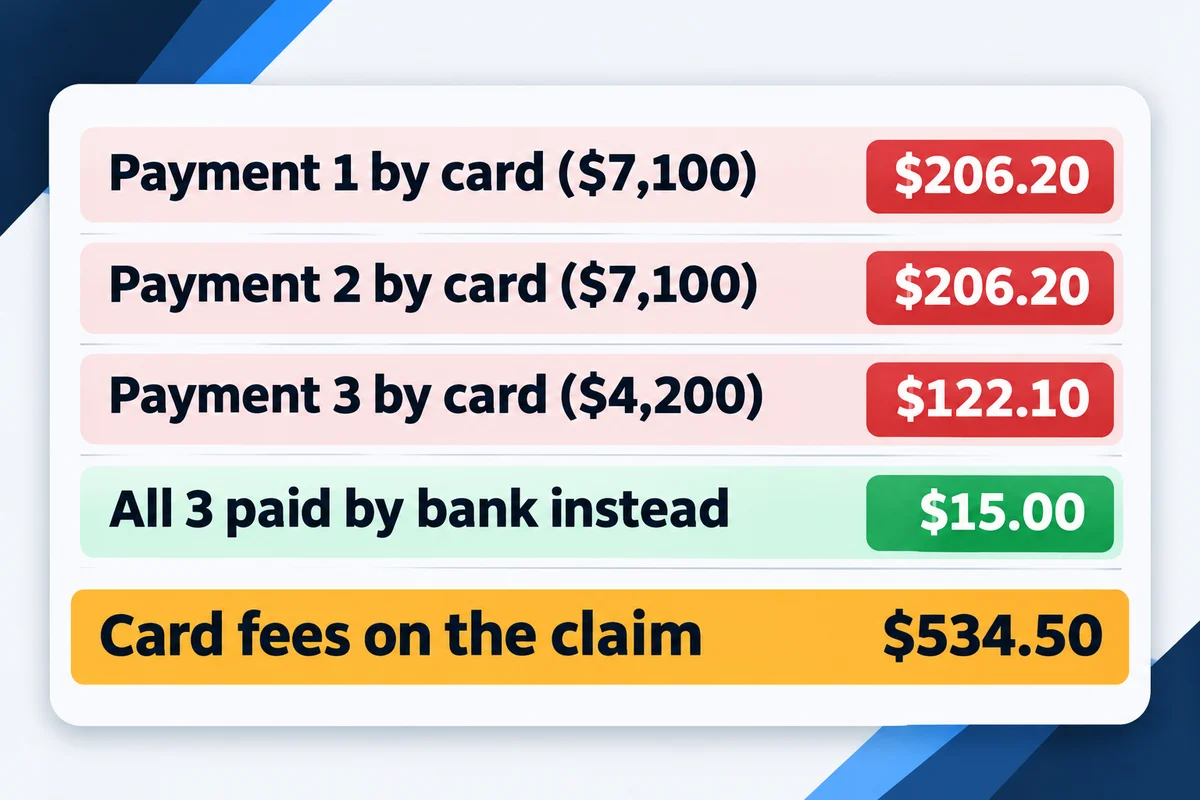
Two things stand out. The third payment is an easy one to put on a card, because the depreciation check can arrive months later and the homeowner may have spent it already. And $534.50 is about half of the deductible on this claim. If you absorb it on every card-paid roof, you are paying a slice of the homeowner's deductible without meaning to, and covering the deductible is exactly what some states forbid. I went through those deductible rules in what contractors can and cannot do about the deductible.
Can the card fee go on the supplement?
No. A supplement asks the carrier to pay for repair work its estimate missed, and a card fee is not repair work. It exists only because the homeowner chose how to pay you. Adding it to a supplement, or folding it into a line item so the carrier pays it without knowing, puts a cost on the claim that is not part of the loss. That is the kind of line that turns a routine claim into a fraud question.
Keep the fee where it belongs: on your invoice to the homeowner, as its own line, visible before they pay. The carrier's checks cover the roof. How the homeowner moves that money to you is a deal between the two of you, and the paperwork should show it that way.
Wording for the contract and the invoice
The surcharge has to be agreed before the first payment, and the cleanest place is the payment section of the contract the homeowner signs. Below is a sample of the lines and what each one is doing. It is a starting draft for your attorney, written for a state that allows surcharges, not a form to print as it is.
Then keep the promise on every invoice. If the job is paid in pieces, each invoice shows both totals for that piece only. A homeowner who sees "$7,100.00 by check or bank, $7,306.20 by card" makes the choice in one second, before the money moves. How a claim invoice is built from the approved scope is on our claim invoicing page.
Surcharge, build it into the price, or push the bank option?
You have three ways to handle the fee, and on insurance work the order I would try them in is this:
- Start by offering a bank payment that costs the homeowner nothing. On the claim above it turns $534.50 into $15.00, and nobody has to talk about a fee at all. Put the bank option first on the invoice, not in a footnote.
- Then surcharge the card, if your state allows it, and only after the processor has confirmed your rate, the contract carries the wording above and every invoice shows both totals. Keep it to credit cards.
- Build the fee into your price only on retail work. On a claim your price is the carrier's estimate, so there is no room to hide a fee in it. On a cash roof or an upgrade the homeowner pays for directly, a slightly higher price can cover the card cost for everyone.
Whatever you choose, write it down once and use it on every job. A rep who waives the surcharge for one neighbour and charges the next one is how a fair fee turns into a complaint. If you take payment plans on the homeowner's share, read the payment plan post too, because a fee charged only to plan payments changes the math there.
How a card or bank payment lands on the claim
In CRM For Claims the homeowner's payment page shows two ways to pay under one Pay button: Card and Bank account. The online payment is always for the invoice's full balance, so each payment of the claim goes out as its own invoice. A homeowner who pays from a bank account sees the page "Your bank payment is on its way" after pressing Pay.
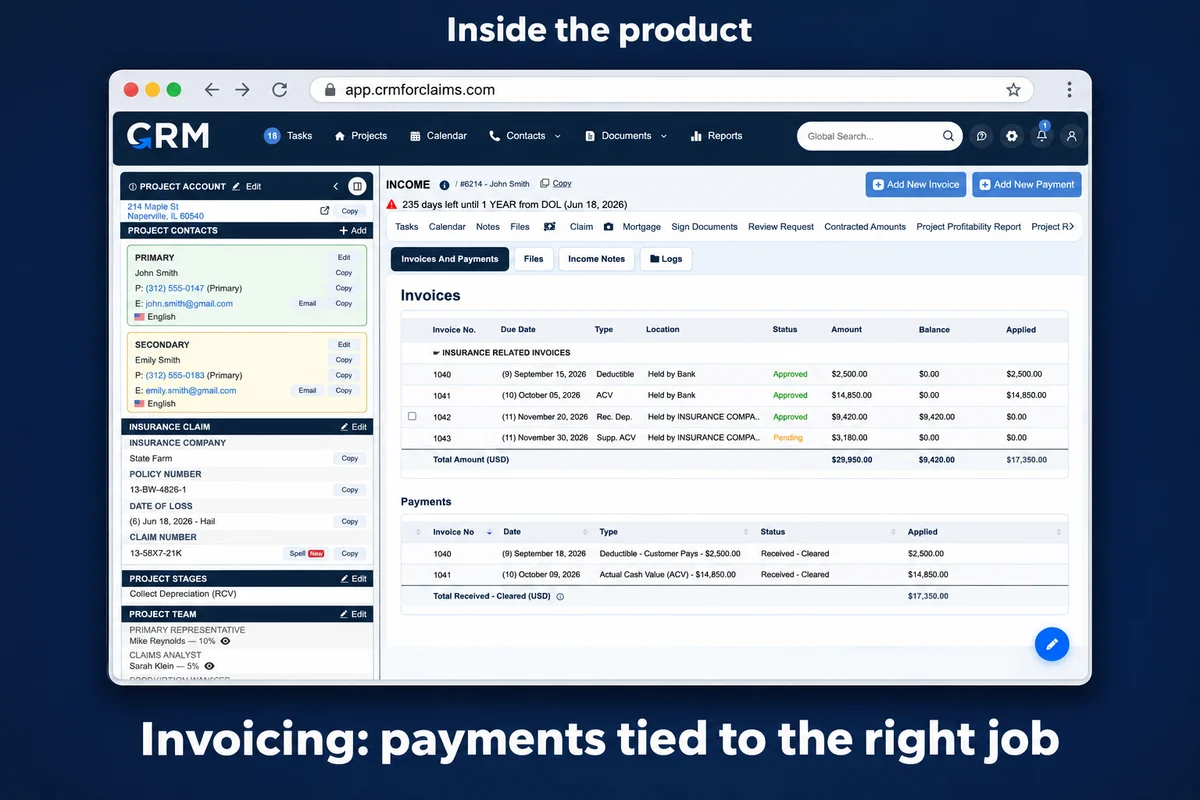
When the money arrives, the payment is filed on the invoice as Credit/Debit Card or as ACH, depending on how the homeowner paid. That gives the office the number this whole post is about: how much of last month's money came in by card, and so what the cards really cost you. The online payments page walks through each step from the homeowner's side and from yours.
If you want to see how a three-payment claim looks with card and bank side by side, book a short walkthrough and bring one of your own claims. I will show you where each payment sits and what it cost to collect.