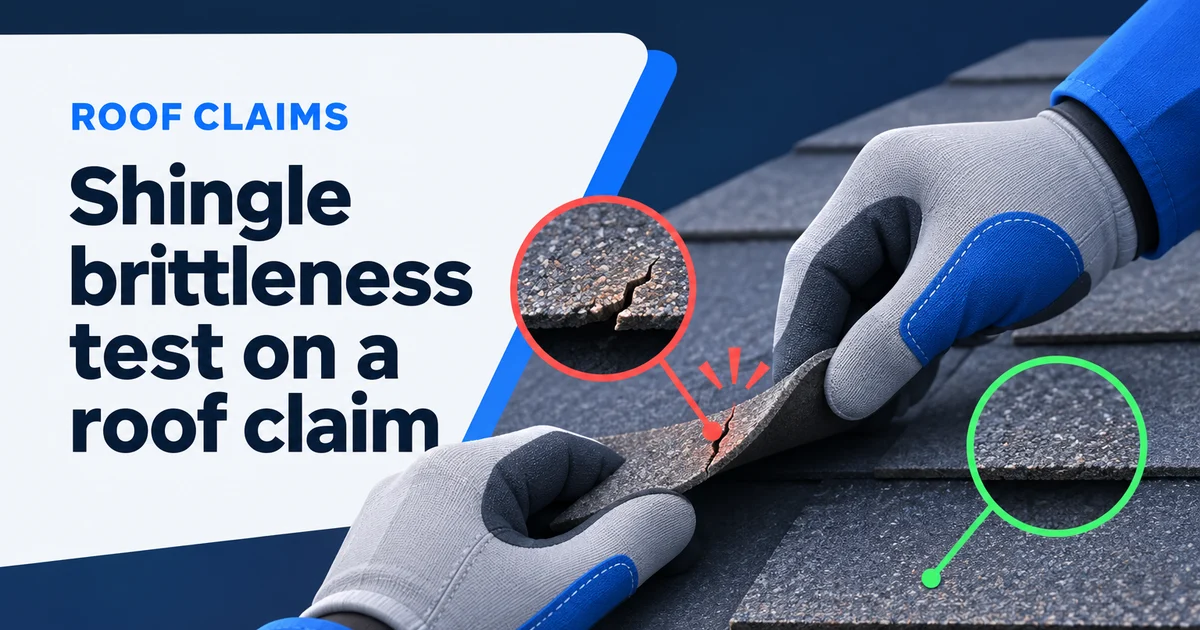
A shingle brittleness test on a roof claim shows one thing: whether the shingles around the damage can be lifted, renailed and resealed without cracking. If they can't, a spot repair breaks more roof than it fixes, and the honest scope is the whole slope. The test only counts if the record shows it was done fairly: in mild weather, on shingles that stand for the slope, at several spots, on video.
I build CRM For Claims, software for roofing and restoration companies that work insurance claims, and this is a fight I see on a lot of hail and wind files. The carrier writes "replace 8 shingles," the roofer says nobody can replace 8 shingles on that roof, and the claim stalls. Below is why the result matters under the rules, what a usable test log looks like, the conditions that get a test thrown out, what the shingle maker says about repairs, and how to turn the result into a request the desk can approve.
Why a failed brittleness test can change the scope
Because breaking good shingles to fix bad ones is damage too, and in some states the rules say the carrier pays for it. Iowa says it in plain words in its claims settlement rule:
On a replacement cost policy, damage the repair itself causes is part of the claim. The rule's words: "any consequential physical damage incurred in making such repair" belongs in the loss, unless the policy excludes it.
Iowa Administrative Code 191-15.44(1)(a), replacement cost policiesRead it from the roof. If replacing 8 hail-hit shingles means lifting the 20 around them, and those 20 crack when lifted, the cracked ones are part of the loss. Your test is the proof that they will crack. Without it, the carrier's 8-shingle repair is a number on paper and your objection is an opinion.
Not every state has a rule this direct, so read your own state's claims rule and the policy. The practical point holds anywhere: a repair that wrecks the slope on the way in can't honestly be priced as 8 shingles. Matching is a separate argument with its own rules, and I covered it in the post on matching undamaged slopes on a claim. Brittleness is about whether the old shingles survive the work at all.
One slope, five lifts: what a test log looks like
The adjuster who reads your file was not on the roof. The log has to let them see the test. Here is a filled example for one slope. The roof, the readings and the results are made up to show the shape of the record, not taken from a real claim.
| Spot | Where on the slope | Surface temp | What happened on the lift | Video |
|---|---|---|---|---|
| 1 | Third course up, 4 ft from the left rake | 71°F | Cracked across the tab at the sealant line | clip 01 |
| 2 | Mid slope, centre | 73°F | Sealant strip let go, tab split at the nail line | clip 02 |
| 3 | Two courses below the ridge, right side | 74°F | Cracked on the first inch of lift | clip 03 |
| 4 | Next to a hail-hit shingle, lower right | 72°F | Lifted without a crack, did not reseal by hand press | clip 04 |
| 5 | Above the plumbing stack, centre left | 72°F | Granules shed, mat cracked along the fold | clip 05 |
Notice what the sheet answers before anyone asks. Which slope and which way it faces, because sun-baked slopes age faster than the north side. Shingle type and age, because a three-tab roof behaves differently from a laminated one. The surface temperature at every spot, and the time. Spots spread across the slope instead of five shingles next to each other. And spot 4, the one that passed, stays in the log. A record that only shows failures looks picked.
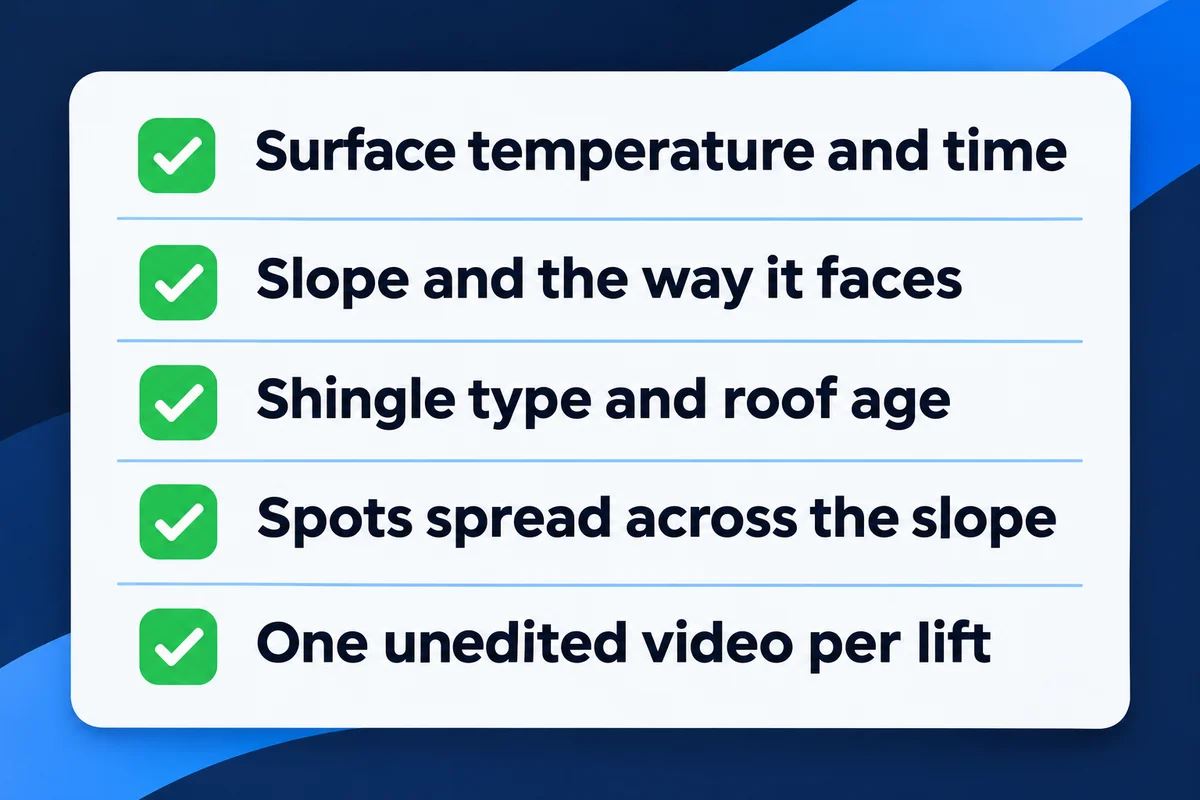
Shoot the video in one take per spot. Start on the thermometer, pan to the shingle, lift slowly with a flat bar, show the result, press it back. A cut between the reading and the lift is the first thing an engineer on the other side will point at.
When the test holds up, and when it gets thrown out
Asphalt gets stiff in the cold and soft in the heat. Every argument against brittleness tests comes back to that, and to the suspicion that the tester chose the worst shingles on the roof. The fix is the same both times: test in conditions nobody can call unfair, and write them down.
The record holds up when
- The slope is in the sun and the air is mild, and both readings are on the sheet
- The spots are spread over the slope, top to bottom and side to side
- Every lift is slow, with a flat bar, on video
- Passes stay in the log next to the failures
- The roof age and shingle type match the permit or the homeowner's paperwork
The record gets thrown out when
- It was done at 8 am in November on a frosty roof
- Every spot is under a tree or at the eave overhang
- The roof is four years old and laminated, and the claim says it can't be repaired
- There are photos of cracked shingles but no video of the lift
- One shingle was tested and the whole roof was called unrepairable
The cold-morning test is the one I see most. A crew goes up first thing, the shingles snap, and the photo goes in the file. Months later, an engineer for the carrier asks what the temperature was. If nobody knows, the test is worth nothing and the crew has to go back up in better weather. Doing it right the first time costs one thermometer and twenty minutes.
What GAF tells contractors about repairing storm-damaged shingles
The shingle maker's own repair instructions are better evidence than anything you say yourself, because nobody can call them a contractor's opinion. GAF's Technical Advisory Bulletin TAB-R-126, Replacement of storm damaged shingles, sets out three things that a spot repair has to include. Each one is a reason the repair needs more than the damaged shingles.
- Nails in the shingles around the repair
Any nails that were removed from surrounding shingles must be replaced and the surrounding shingles must be resealed by hand.
Replacing one shingle means pulling nails from the ones above it. Those neighbours are the shingles your test lifted.- Hand-sealing instead of waiting for the sun
- Where sealant bonds broke in the storm or during replacement, GAF recommends hand-sealing
rather than depending on the shingles to reseal themselves.
If spot 4 in the log above would not reseal by hand press, write that down; it's the same point. - Replacing a whole plane
- GAF says latent damage around storm-hit shingles
is difficult to assess
, and that if the damage is confined to one plane,replacement of just the damaged roof plane may be possible.
That is your fallback request when only one slope is hit.
The same bulletin says that adding loose granules to a damaged shingle with asphalt cement, which it calls "sugaring," is not a permanent repair.
If the carrier's estimate implies patching, attach the bulletin. Save the PDF in the claim file, not just a link, because manufacturers revise these documents.
Turning the result into a request the desk can approve
A test result on its own doesn't move a claim. What moves it is a specific request that matches what the test and the damage map show. Two questions decide which request you send: did most spots fail, and is the hail or wind damage on one slope or spread across several?
Send the request in writing, name the slopes the way the adjuster's estimate names them, and ask for a reinspection with the adjuster on the roof if the desk won't move on paper. Offer to do the lift with them present, at the same spots, on a mild afternoon. A carrier that won't watch the test has a harder time arguing with the video.
If the test was part of your first visit, it belongs in the same record as everything else you measured. The post on what a roof inspection report should record covers the rest of that sheet.
Where the test result lives in CRM For Claims
The test is only as good as your ability to find it eight months later, when the supplement is disputed and the crew lead has moved on. In CRM For Claims, the roof inspection checklist asks for the material of the top layer, with 3-tab and architectural shingles as separate choices. The same checklist records the predominant slope as a Pred. Slope Factor, from 1/12 to 12/12 or Mansard. Those two answers are the first things an engineer will check your test against.
Every project comes with built-in folders, and two of them fit this job. The Weather Verification Reports folder holds the storm report that dates the damage. The Insurance Claim Coverage Documents folder holds the carrier's estimate and their letters, so the "replace 8 shingles" line sits right next to the log that answers it. The follow-up on the request is a task on the claim with a Task Due Date, so it doesn't depend on someone remembering.
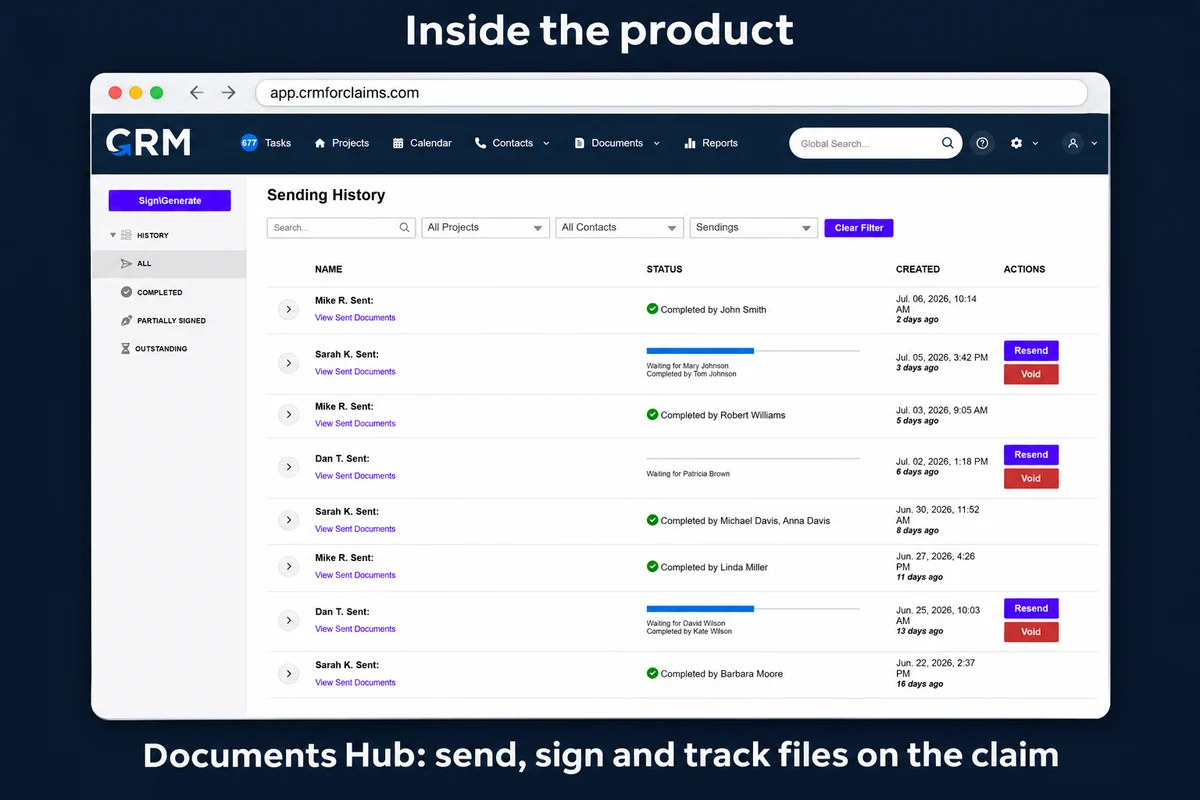
You can see the rest of what the app does on the features page, how it compares with general contractor software on the comparison page, and what it costs on pricing. If you want to see a claim file set up the way this post describes, book a live walkthrough and bring one of your own disputed roofs.