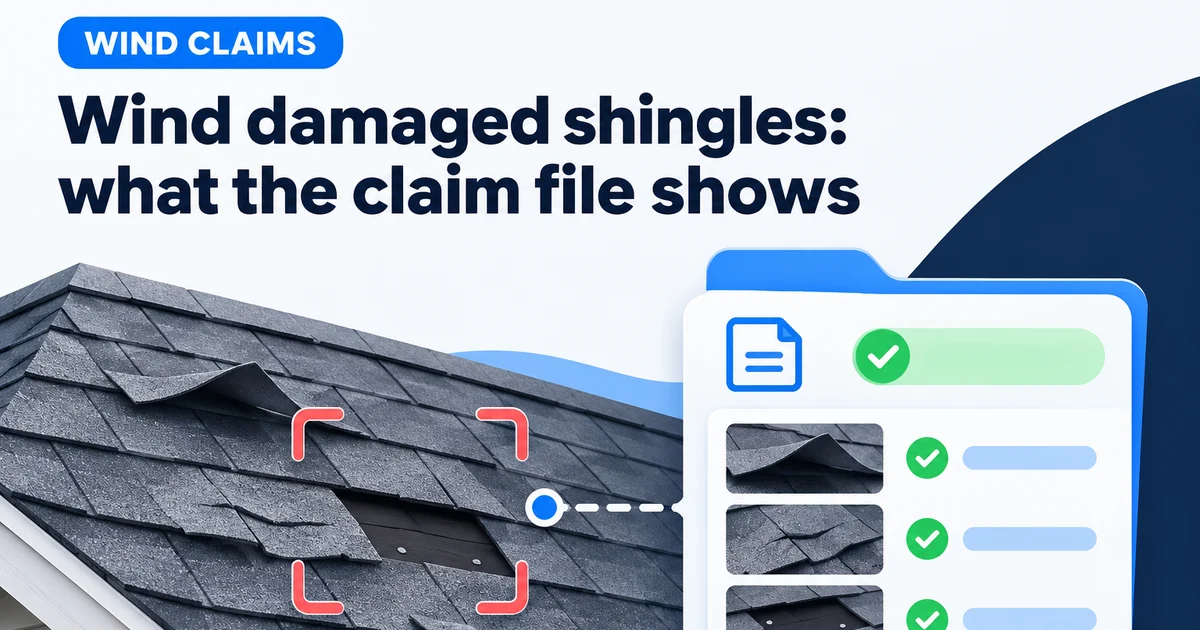
A wind damaged shingle on a roof claim has to show a mark the wind left: a crease, a tear, a fold or a missing piece. A shingle that is only unsealed, lifts by hand and has none of those marks is the one carriers push back on. What wins a wind claim is a file with three things in it: the marks, a pattern on the roof that fits how wind behaves, and a dated storm with a wind speed that can explain both.
I build CRM For Claims, a CRM for roofing and restoration companies that work insurance claims, and wind files are where I see good roofs get denied for thin paperwork. The roof was damaged. The file said "wind" and showed twenty close-ups of lifted tabs, and nothing else.
What does wind damage on shingles actually look like?
Wind lifts a tab, the sealant lets go, the tab flaps, and each flap bends it at the same line until it creases, tears or leaves. Those marks are the evidence, and adjusters and the carrier's engineers do not weigh them the same way.
Missing tabs or whole shingles
The plainest mark. Find the pieces in the yard or gutters if you can, and photograph the exposed nails and the clean strip where the tab used to sit.
Torn or folded tabs
A tear usually runs across the top of the exposed part, just under the shingle above. A fold that stayed folded is hard to argue with.
A crease line
On a newer, soft shingle the crease can be faint. You may need to press a hand under the tab to see it. Expect the carrier to ask how it got there and when.
A granule rub line
A thin bare line an inch or two below the shingle above, where a loose tab rubbed while it flapped. Owens Corning lists it as a sign the seal broke.
Unsealed, but no crease, tear or fold
The tab lifts with a finger and springs back clean. This is the shingle most wind denials are written about, and the next section is about it.
Curling or cupping across the roof
Shingles that curl on every slope at once point to age or heat, not a storm. Shoot it anyway, so nobody can say you hid it.
The unsealed shingle with no crease
This is the shingle the whole argument turns on, and two experienced camps disagree about it in print. You do not have to pick a side. You have to bring the evidence that answers both.
Haag Engineering, 2018
any sealed-down shingle affected by wind will leave lasting evidence
Their paper in the IIBEC journal says an unsealed tab without creases, folds, tears or missing pieces is not evidence of wind. It names other reasons tabs come unsealed: age, cold-weather installs, dirty sealant and nails driven into the sealant strip. Read the paper on iibec.org.
Lewis O'Leary, forensic investigator
the initial crease would occur under the overlap, not at the overlap
His reply argues the first bend forms under the shingle above, out of sight, and that Haag's own test ran at 119 mph while seal strips carry a rating near 60 mph. He tests seal strips cool, closer to storm conditions. Read his post.
Both camps agree on more than the fight suggests. Wind does lift poorly sealed tabs. Not every unsealed tab is wind. So the useful question for your file is narrow: does the unsealing on this roof sit where wind hits hardest, and did a storm with enough wind pass over this address on the date of loss? If yes to both, your unsealed tabs are part of a story. If they are spread evenly over every slope, they are a maintenance item, and a claim built on them tends to come back denied as wear and tear. I covered that letter and the reply to it in what the roofer can show after a wear and tear denial.
The pattern across the roof does most of the arguing
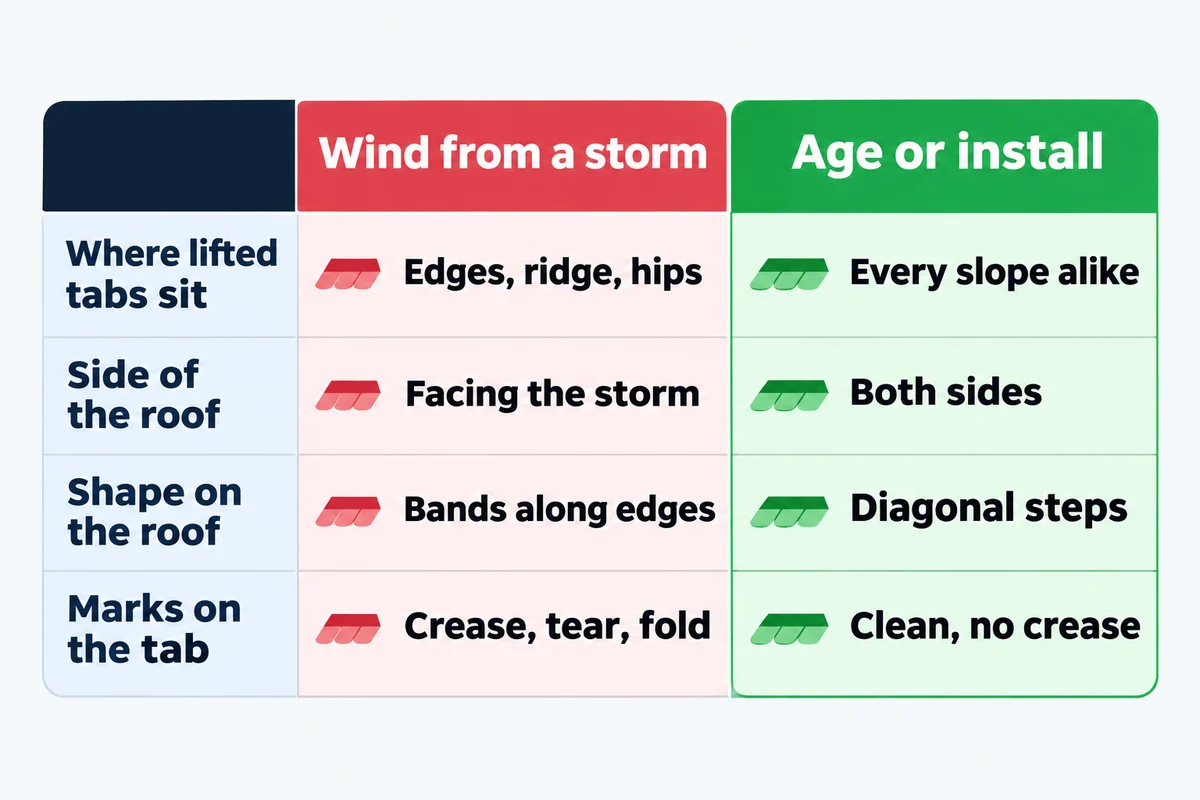
One shingle proves little. The map of all of them proves a lot. Wind lifts hardest at the edges of a roof plane: eaves, rakes, hips and the ridge, and more on the side the storm came from. Age and installation problems do not care about the wind direction. They repeat across every slope in the same shape, often a diagonal stair-step that follows how the shingles were laid, or a straight vertical line on a racked install, which roofers call zippering.
A pattern that fits a storm
Top: windward slope. Bottom: leeward slope. Dark ridge line between them.Damage packed along the eave, rakes and ridge of the slope facing the storm, little on the far side.
A pattern that points to age or install
Same roof, same legend. Blue cells are unsealed or lifted tabs.The same diagonal steps on both slopes, whatever side the wind came from. That reads as how the roof was laid.
So before anyone writes "wind" on the claim, sketch the roof and mark every lifted, creased or missing tab on it, slope by slope, with a compass arrow. It takes ten minutes on a tablet and it answers the pattern question before the carrier asks it.
Age matters here too. The University of Florida study cited in the Haag paper found shingles tend to stay sealed for their first four or five years, and that unsealing becomes more common after that. On a two-year-old roof, a band of lifted tabs on one side after a storm is hard to explain any other way. On a twenty-year-old roof, expect the age question first.
Insurer, shingle maker or installer: who gets the claim?
Wind damage to shingles can land on three different desks, and filing at the wrong one costs weeks. Owens Corning's storm page puts the rule simply: if the wind that did the damage was above the shingle's warranted wind coverage, it is an insurance claim; if it was below, the homeowner files with the manufacturer. Work down these questions in order.
Was there a storm, and how fast was the wind?
Pin the date of loss and the highest wind speed reported near the address that day. No storm in the record, no wind claim. How to pin the date is in our post on the date of loss.
What wind is this shingle rated and warranted for?
Read the brand and line from a leftover bundle, the wrapper in the attic or the original invoice. The test class on the wrapper and the warranty's wind coverage are two different numbers, and the warranty sets the line Owens Corning describes.
How old is the roof?
Under about five years, widespread unsealing after a mild storm leans toward the manufacturer or the install. Older roofs lean toward the age argument.
Do the nails and courses look right?
High nails, nails in the sealant strip and a racked pattern point at the installer. If that is you, it is a warranty callback, not a claim.
The test classes most wrappers print come from two standards. These speeds are as Owens Corning lists them on its page on shingle wind resistance:
| Standard | Class | Wind speed tested or resisted |
|---|---|---|
| ASTM D3161 (fan test) | A / D / F | 60 / 90 / 110 mph |
| ASTM D7158 (uplift test) | D / G / H | 90 / 120 / 150 mph |
A 60 mph gust on a Class F roof does not mean the claim fails. Seal strips, age and install all sit under the class, which is the point O'Leary makes. It does mean the file needs more than the speed: it needs the pattern and the marks.
Shoot it in this order, before anyone lifts a tab
Lifting tabs changes the roof. A cold tab can crack, and a warm one can crease under your hand, and then nobody can say which crease came first. Photos taken in this order hold up on a reinspection with the adjuster because the file shows the roof before anyone touched it.
- Each elevation from the ground with the house number in frame, then each slope from the eave, with a compass direction written in the photo note.
- The roof sketch with every marked tab, before any close-ups.
- Missing pieces and debris in the yard and gutters, where they landed.
- Each crease, tear and fold untouched, with a tape or chalk mark for scale.
- The outdoor temperature and the time, written down, then the same tabs lifted by hand, one photo per tab.
- Undamaged slopes too. A clean leeward slope supports the wind story instead of hurting it.
- The bundle wrapper or label that shows the brand, line and wind class.
Where the storm and the roof live in CRM For Claims
The storm has to be on the claim, not in someone's memory of "that Tuesday in June". A storm record in CRM For Claims holds the storm date and time, a storm note, the largest hail size in inches and the highest wind speed in miles per hour. You mark the cities or ZIP codes the storm hit on the same record.
On a claim, Wind is one of the choices for type of loss. When the type of loss is Wind, the date of loss list offers only storms saved as Wind or as Hail and Wind. Each storm in that list shows its date, its type of loss, its note, the largest hail size and the highest wind speed.
The roof inspection checklist on the project records the material of the top layer and of up to three layers below it. Keep the photo of the bundle wrapper with the rest of the job photos. The storm and date of loss tracking page shows how storms and claims connect.

Everything else the CRM does is on the features page. If you run wind claims and want to see a storm tied to a claim with your own roofs, book a live walkthrough and bring one wind file that came back denied.