Overhead and profit on a roof insurance claim is owed when the repair reasonably needs a general contractor to run it, and how many trades the job has is only evidence of that. It's usually written as 10 and 10, a 20% addition to the trade costs. A plain roof replacement is the hardest case to make. A roof with siding, gutters and interior repairs has a real argument.
I build CRM For Claims, a CRM for roofing and restoration companies working insurance claims. You can lose this line without any fight at all: the scope comes back without it, nobody asks in writing, and the file has nothing showing who coordinated what.
Does a roof-only claim get overhead and profit?
Usually not, and I wouldn't spend a day fighting for it on a simple reroof. The argument for overhead and profit is that somebody has to coordinate different trades, and one roofing crew on one roof gives you little to point at. Add other kinds of work, a permit and a sequence that matters, and the answer starts to move.
I'd rank the jobs that come through a roofing office like this, from the weakest request to the strongest. This ladder is my own judgment and not a rule from any carrier, so treat it as a way to decide where your time goes.
Repair of a few shingles
One crew, one morning, nothing to coordinate. Leave it alone.
Full reroof, nothing else
A permit and a dumpster aren't much of a case on their own. Ask only if something unusual is going on.
Roof and gutters
Two lines, and often the same company doing both. Weak, unless a separate gutter sub has to work around your crew.
Roof, gutters and siding on one elevation
Now the order of work matters, because flashing and siding meet. This is worth a written request.
Roof, siding, gutters and windows
Different subs, different materials, and each one waits on another. A strong request.
Roof plus interior: drywall, paint, insulation
The inside can't start until the roof is dry, and homeowners are living in the middle of it. The strongest case on this list.
Is the three-trade rule actually a rule?
Not in anything I read today. It's a habit of the claims business that says three trades means a general contractor, and adjusters will quote it to you as if it were policy wording. The Texas bulletin and the summary of the Florida decision below don't turn on a count at all. So a two-trade job can have a real argument, and a three-trade job isn't automatically owed anything.
That helps you, because the question you should be answering is whether a homeowner would reasonably need someone to run this repair. Counting trades on the phone with a desk adjuster gets you an answer of "you have two." Describing the sequence gets you a conversation.
| State | Source | What it says | On your roof job |
|---|---|---|---|
| Florida | Hunton alert on Trinidad v. Florida Peninsula (Fla. 2013) | Replacement cost covers a general contractor's overhead and profit when the homeowner will probably need one, and that holds even before repairs are made. | The carrier may hold it back if nobody shows that a general contractor is likely to be needed. Make that showing. |
| Texas | TDI Bulletin B-0068-08 (2008) | Deducting prospective contractor overhead and profit, on top of depreciation, when calculating actual cash value is an improper settlement practice. | Where it belongs in the scope, it shouldn't vanish from the first check. Texas also won't back charging for services not rendered. |
Those are two states, both sources are more than a decade old, and your state may read differently. I'm not a lawyer, and policy forms vary too. If this line matters on a big loss, read your own department of insurance's bulletins and ask your attorney before you put a legal claim in writing.
What the money does on one scope
I made up this example to show the timing. The trades total $20,000, the 10 and 10 adds $4,000, the deductible is $2,000 and depreciation is held at a flat $3,000 to keep the sum readable. In real scopes depreciation may touch those lines as well.
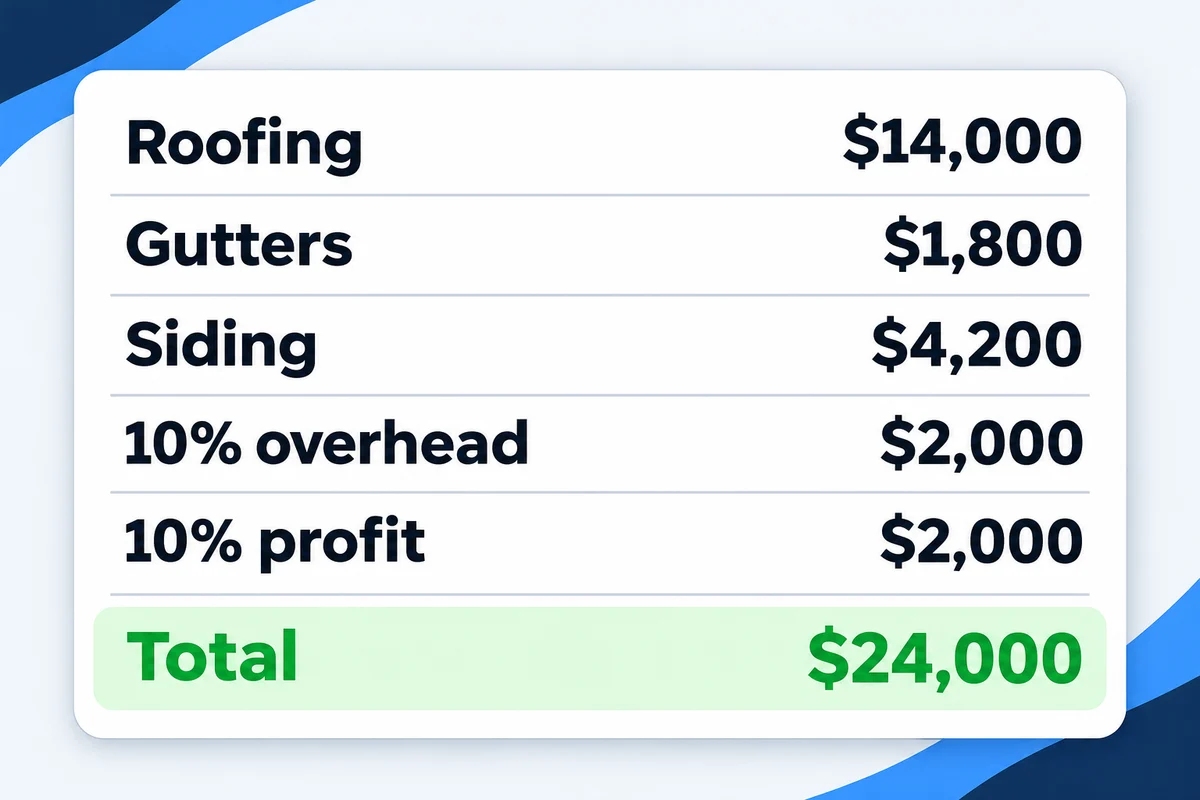
Outcome 1: included from the start
Outcome 2: held until the work is done
Outcome 3: left off and never asked for
Outcome 2 costs you cash flow for the length of the job, and outcome 3 costs you the money. It's the same kind of arithmetic I work through in recovering depreciation after the work is done, and the summary lines are explained in how to read an insurance scope.
What to send back when the desk says no
Ask for the reason in writing, then answer that reason. Use your own words, and have the homeowner's authorization on file before you talk to the carrier about their claim. What you're allowed to discuss varies by state, and the people who own each part of the claim should be clear before anyone writes.
- "You only have two trades."
- List the work in the order it has to happen and say who waits on whom. Ask which policy wording requires three.
- "We pay it when a general contractor is hired."
- Send your signed contract if you're the one running the job. In Texas and Florida, point to the source in the table above.
- "You're a roofer, not a general contractor."
- Show what you did: permit pulled, subs scheduled, deliveries ordered, inspection booked. If your state licenses general contractors, check your own license before you lean on this.
- "It's already in your unit prices."
- Ask them to show where. Then look hard at your own number, because if your price really does include it, you can't ask for it twice.
Bill for the coordination you actually did
This line cuts both ways. Texas says plainly it won't support contractors charging for services that weren't rendered, or charging twice for overhead and profit. If you add 10 and 10 to a scope, the job needs to show the work behind it, and your final invoice has to agree with what the carrier was told. Keep these in the file from the first week:
- The carrier's scope, with every revision, so you can see when the line appeared or disappeared.
- Your contract, showing who is responsible for the whole repair.
- Each sub's agreement or invoice, with its trade named.
- The schedule, including what had to wait for what.
- Permits and inspection results.
- Your written request and the carrier's written answer.
Six plain things, and most offices already have them scattered across a phone, an inbox and a filing cabinet. If the supplement comes through, treat it like any other: supplements and approvals covers keeping that money straight.
Where trades and overhead live in CRM For Claims
A request like this rests on facts kept with the job. In CRM For Claims, the Contracted Amounts page lists each trade on a project with its original, additional and total contracted amount. Trades and their first amounts are recorded when a Project Contract is uploaded in Project Files. Every expense has to be assigned to a project trade, so sub costs land against the work they paid for.
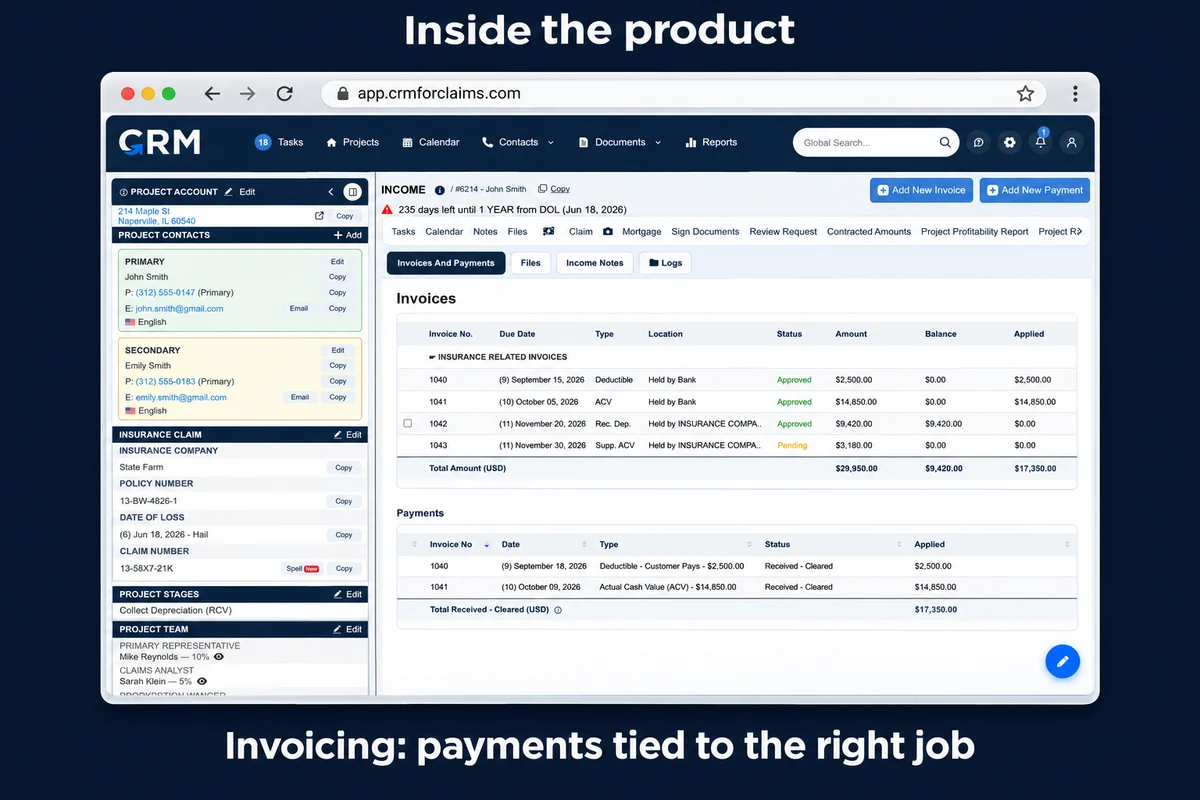
The Project Profitability Report by Trade shows the contracted amount, trade expenses, general overhead share, profit and percent for each trade. General Overhead expenses on the project are split across the trades in proportion to their contracted amounts. That gives you your own figure to compare with a 20% line. When the carrier adds money later, it can go on its own Supplemental ACV invoice. Following up on the request goes in as a task, and every task has a required Task Due Date.
The job costing page shows that report on one job, and supplement tracking shows how the extra money is counted. If you want to see your own multi-trade job set up, book a walkthrough and bring the scope that left this line off.