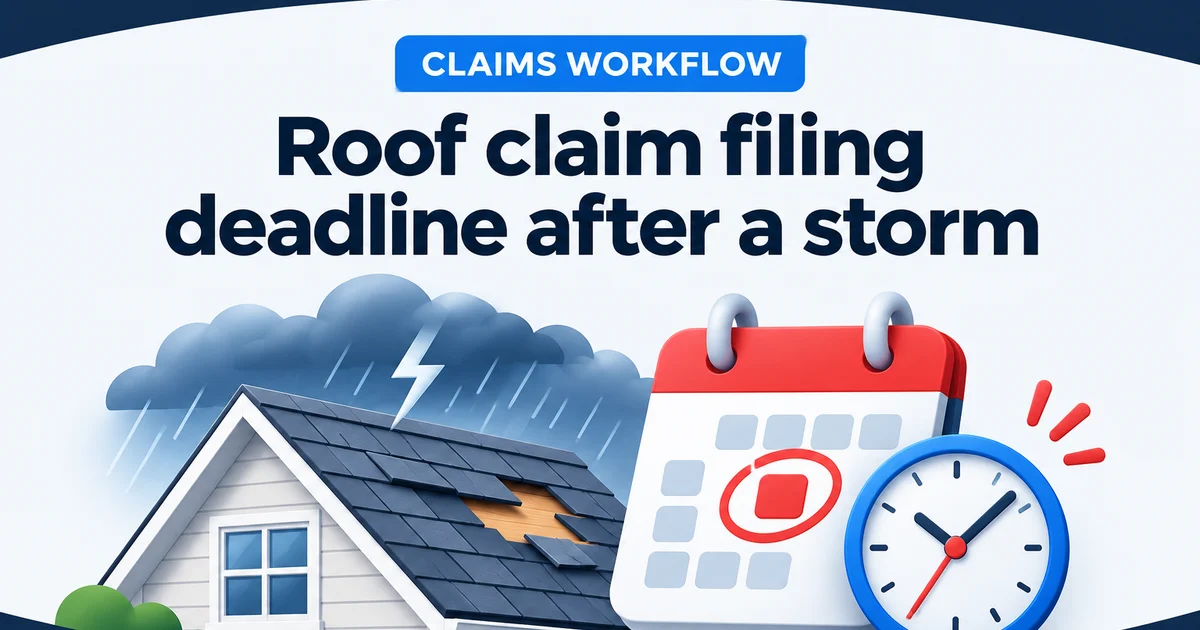
The roof claim filing deadline after a storm is usually one year from the date of loss, but that number is only one of three clocks. The policy also asks for notice "promptly", which carriers read as weeks, not months. And there is a separate clock for suing the carrier if the claim goes wrong. A roofer who knows which clock a homeowner is on can tell, at the door, whether the job is a claim or a retail sale.
I build CRM For Claims, a CRM for roofing and restoration teams that work insurance claims. Late filings are one of the quiet ways good roofs turn into denied claims, and they almost never show up as "we missed the deadline". They show up as a carrier asking why nobody said anything for nine months.
Three clocks start on the day of the storm
All three run from the date of loss, so the first job is getting that date right. If you are not sure how, I wrote up how to pin down the date of loss on a hail claim. Once you have it, these are the clocks to watch.
Notice of the loss
Most homeowner policies tell the insured to give the carrier prompt notice of a loss. There is no number in that word, and that is the point: the carrier decides later whether the wait was reasonable.
Where it is written: the duties after loss section of the policy.
Filing the claim
Many wind and hail policies, and some state laws, set a hard limit for filing the claim itself. One year from the date of loss is the common number. Some policies allow two.
Where it is written: the policy conditions or a wind and hail endorsement, and in some states the insurance code.
Suing the carrier
The policy's "suit against us" clause limits how long the insured has to take the carrier to court. State law often sets a floor that the policy cannot go under.
Where it is written: the suit against us condition, and the state's insurance code.
The mistake I hear most often is treating the third clock as the first one. A homeowner reads online that they have "two years" or "four years", and that is true for a lawsuit in some states. It says nothing about how long they can wait to call the carrier about the roof.
What Texas law actually says about the one year
Texas is the one state where hail filings are common enough, and the statute clear enough, to show how the clocks fit together. Two sections of the Texas Insurance Code set the filing year, and both have a way out for a late filer.
Section 2301.010, wind and hail policies
"a provision requiring that a claim be filed with the insurer not later than one year after the date of the loss"
The same subsection says such a policy must also allow a claim after the first anniversary "for good cause shown by the person filing the claim." Subsection (b) puts a floor under the suit clock: no earlier than two years after the carrier accepts or rejects the claim, or three years after the loss, whichever comes first. Read section 2301.010.
Section 2210.205, TWIA policies
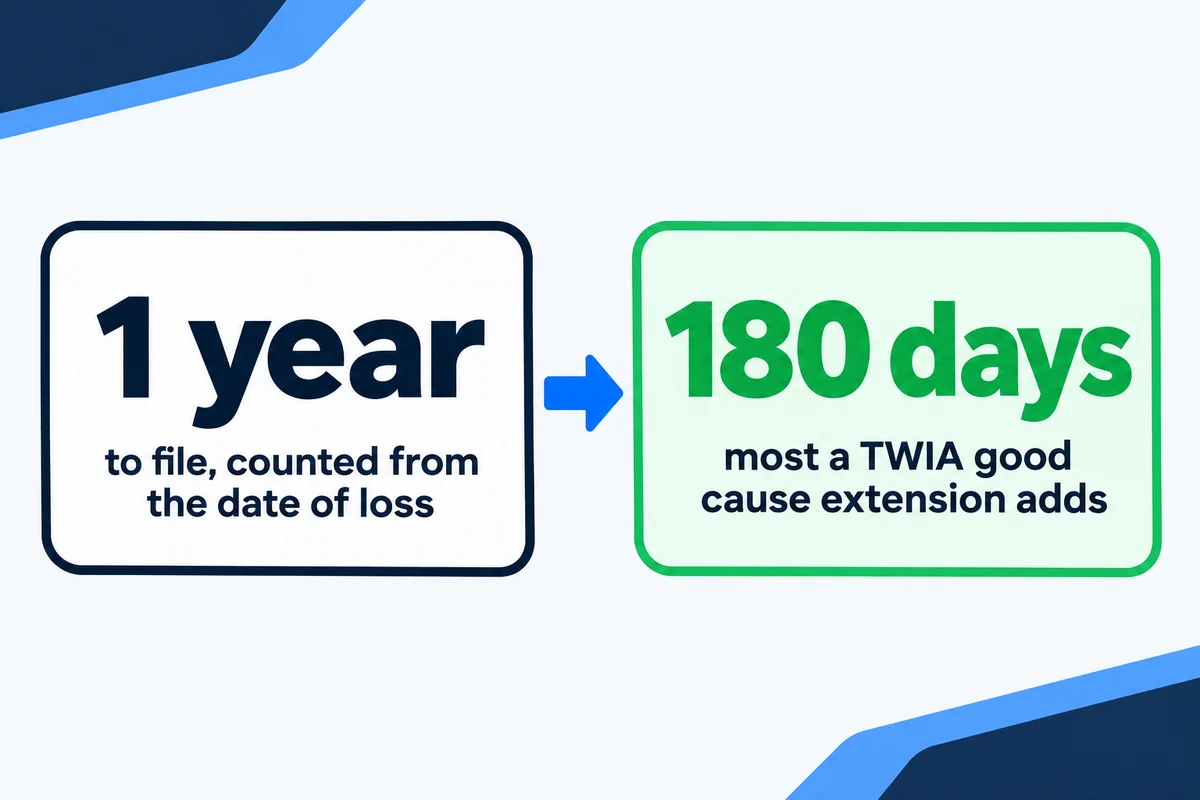
"require an insured to file a claim under the policy not later than the first anniversary of the date on which the damage to property that is the basis of the claim occurs"
Here the extension is not the carrier's to give. The commissioner of insurance may extend the year for good cause, "for a period not to exceed 180 days." Read section 2210.205.
A real storm shows how literal the year is. Hurricane Beryl came ashore in Texas on July 8, 2024. The Texas Department of Insurance then told coastal homeowners that July 8 is the deadline to file a claim with the Texas Windstorm Insurance Association, meaning July 8, 2025. The deadline was the anniversary of the storm itself, not the end of that month.
Outside Texas, do not guess from a neighbour state. Some states fix the suit clock in statute and leave the filing year to the policy. Others leave both to the policy. The policy in the homeowner's hand is the document that decides, so the office should read the conditions page of every claim it takes, and write the dates down.
Why waiting inside the year still hurts the claim
Filing on day 340 can be on time and still be a weak claim. The carrier will ask what happened between the storm and the call, and every month adds a new answer it can choose instead of yours.
The first answer is another storm. Hail seasons do not stop after one event. A roof inspected eleven months after a May storm may have been hit again in June and in August, and the adjuster can fairly ask which of the three did the damage. Carriers subscribe to hail history reports, so they know about the later storms even if the homeowner does not.
The second answer is the roof's own ageing. Granule loss, cracked sealant and lifted tabs show up on old roofs with no storm at all. The longer the gap, the easier it is to write the damage off as wear and tear, and that letter is harder to argue with than an on-time inspection. I wrote about what a roofer can show after a wear and tear denial, and most of it is evidence that was easier to get in month one.
The third answer is interior damage. A small hail bruise that lets water in can rot decking and stain a ceiling over months. Most policies exclude damage from continuous seepage over time, so the leak that finally makes the homeowner call can be partly excluded because nobody called about the roof sooner.
And notice can fail on its own. A carrier can deny a claim filed inside the year because notice was not prompt, and in many states it then has to show that the delay actually hurt its investigation. That is a fight the homeowner should never have to have, and an on-time call avoids it.
A door knock in month ten: what to ask before you sign anything
One kind of lead tests a roofing office more than any other. Your rep knocks on a door on May 2. The homeowner says the big hail was last June, they never called anyone, and the roof is leaking now. If last June means June 20, the year runs out on June 20, and you are already deep into it.
Example only. The real end date is the one written in this homeowner's policy, counted from the storm date you can prove.
On a lead like this, these are the questions your rep should get answered before anyone signs a contingency or an inspection request.
- Which storm, on which day?
- Get a date, then check it against a storm you have on record for that address. "Sometime last summer" is not a date of loss, and a filing on the wrong storm can be denied on its own.
- Has anyone already told the carrier?
- A phone call to the agent last summer can count as notice. If there is a claim number already, the file is in a very different place than if nobody ever called.
- What does the policy say about filing and suit?
- Ask for the declarations page and the conditions. Look for a filing limit on wind and hail and for the suit against us clause, and write both end dates on the job.
- Has the roof been hit since?
- A second storm does not kill the claim, but it changes which date of loss is the strongest one. Better to know now than at the inspection.
If the year is close, the homeowner files first and the paperwork follows. The claim can be opened by phone the same day, and the proof of loss, photos and estimate can come after. I wrote separately about what the roofer supplies for the proof of loss. Once the claim is in, the deadlines switch sides and the carrier is on the clock, which I covered in how long insurance has to respond to a roof claim.
Where the deadline lives in CRM For Claims
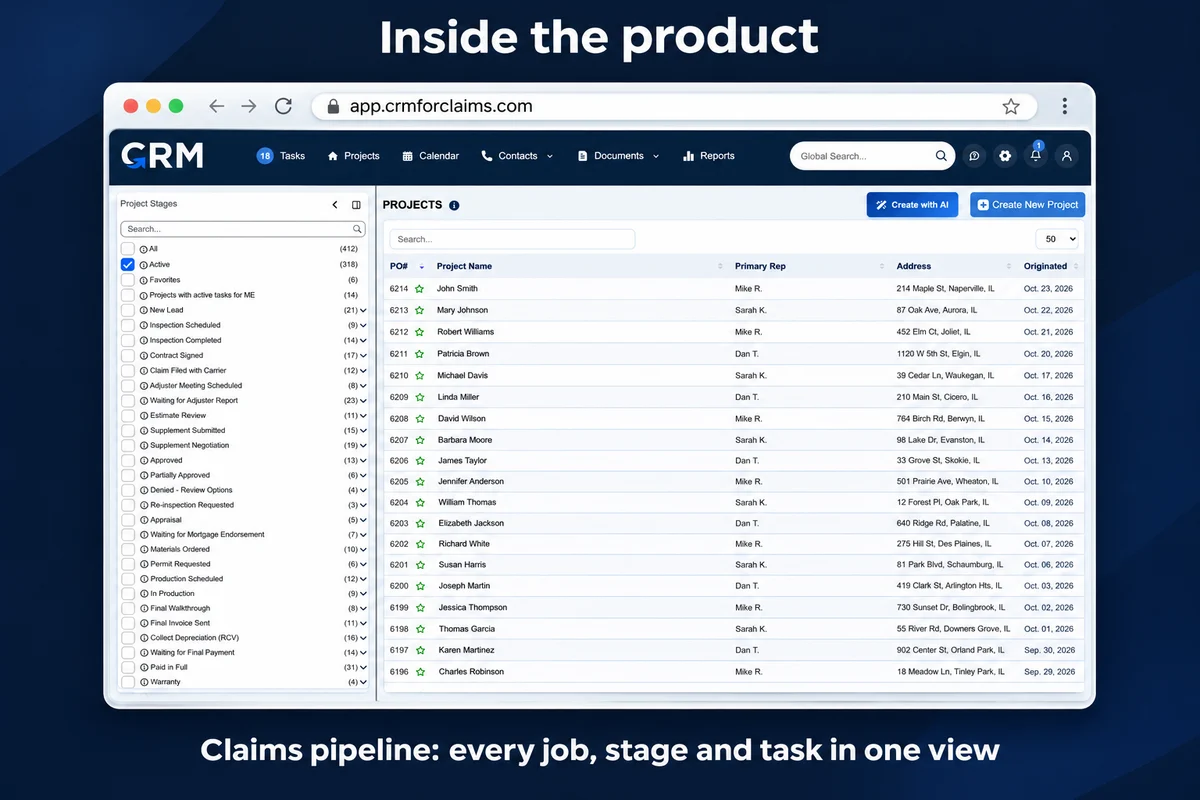
A filing deadline that lives in a rep's head is gone when that rep goes on vacation. In CRM For Claims, the claim status starts at Claim Needs to be Filed, and from there it moves to Filed, Approved, Denied or Closed. Every claim that nobody has filed yet carries that status until someone changes it, so the unfiled ones are easy to find.
The date of loss on a claim is picked from a list of the storms your company saved, each shown with its date, instead of being typed from memory. The claim also holds the policy number and the claim number once the carrier gives one.
For the end date itself, you add a task, assign it to a user, attach it to the project and pick its due date from the calendar. The person who owns the claim sees it coming instead of finding it after. The storm and date of loss tracking page shows how storms and claims connect.
The rest of what the CRM does is on the features page. If your office takes late storm leads and you want to see how a claim, its storm and its deadline sit together, book a live walkthrough and bring the oldest lead in your pipeline.