Short answer: A second market is not more of the same work. It is a second set of rules — licensing, workers compensation, sales tax, permits, price lists — running on a process that quietly assumes market one. Reset those defaults and name one owner per claim before you worry about crew capacity.
I build CRM For Claims, and the multi-location conversation almost never arrives early. It arrives about four months after the second market opened, when a permit has been refused, an invoice came back short on sales tax, and nobody can say who is chasing the adjuster on a claim ninety miles from the office. Running claims across two markets was never hard because of the work. The work is the same work. What broke is everything the process assumed without ever being asked.
This is not the storm-surge problem, where volume spikes and the constraint is bodies. Two markets can be quiet and still fall over, because the failure is structural rather than numerical.
What actually changes when you run claims in two markets?
Not the work. A wind claim in market two has the same stages, the same paperwork and the same carrier behaviour as one in market one. What changes is the environment underneath it: who licenses you, who insures the crew, what tax you charge, who issues the permit, which adjusters you know, and which regional price list the scope is written from. Those are defaults, and defaults travel badly.
A default is a decision your process stopped making because the answer was always the same. Nobody decides which permit office to call — they call the one. Nobody decides the tax line; the template has it. The decisions are invisible, so nobody thinks to re-open them.
| What | Travels to market two? | What it costs if you assume it does |
|---|---|---|
| Your stage list, templates and paperwork | Yes | Nothing — this is the part that ports cleanly |
| Contractor licensing or registration | Sometimes | A refused permit, or work performed unlicensed |
| Workers compensation coverage | Sometimes | An injury with no coverage, and an audit finding |
| Sales tax rate and what is taxable | No | An invoice short by the tax you never charged |
| Permit office, fee and lead time | No | A crew booked for a day the permit will not exist |
| The adjusters you know by name | No | Every conversation restarts from zero |
| Supplier pricing and delivery radius | No | Margin you costed in market one and cannot get here |
Do you need a second CRM account, or one account with two markets?
One account, in almost every case. The test is not how far apart the markets are — it is whether they share a legal entity and a profit-and-loss statement. One company operating in two places is one company, and splitting it across two logins buys nothing except double entry, two half-views of the same backlog, and a customer who moved between markets existing twice.
The exception is real. If market two is a separate legal entity with its own books, its own ownership split, or a plausible future as something you sell on its own, it is a separate business that happens to share your name. Give it its own account and accept the duplicated contacts. Everyone else is better off with one account and a market field on the claim.
The cost question follows. A second market usually adds one or two people who write into the system — a market lead, maybe a coordinator — which is a seat question, not a subscription question. On our plans and per-seat pricing that is $39 per month per additional user on top of the base plan, not a second $59 or $99 subscription. The full arithmetic is in the guide to what per-user pricing actually costs as a team grows.
Which defaults are quietly pinned to your first market?
Six of them, and every one is checkable in an afternoon before the first job rather than discovered on the fourth. Licensing, workers compensation, sales tax, permits, the regional price list your scope is priced from, and your supplier account. None of these are exotic. They are boring, which is precisely why they get skipped.
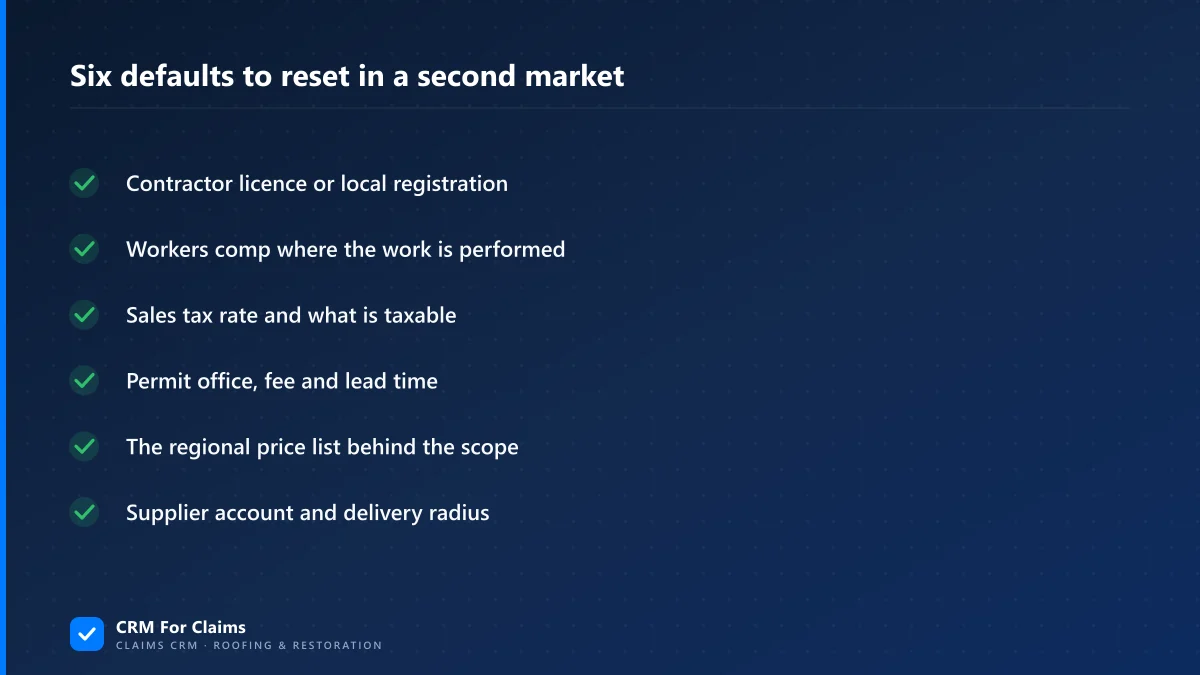
Licensing is not consistent between states, and it is not always at state level. Illinois licenses roofing contractors under a statewide act, with limited and unlimited licence types and a named qualifying party in responsible control (IDFPR roofing contractor licensing). Other states have nothing at state level and leave registration to the city or county, so the answer in market two may be a municipal clerk rather than a state board. Do not generalise from what market one required.
Workers compensation follows where the work is performed, not where you are based. Washington states this about as directly as a regulator can: out-of-state employers "must report all work done in Washington that requires a contractor registration, or an electrical or plumbing license" (Washington L&I, out-of-state employers). Reciprocal agreements exist with several neighbouring states for temporary work — and the Montana and Nevada agreements specifically exclude construction. That is the shape of the risk in one example: reciprocity that looks like it covers you, with a carve-out for exactly the work you do.
Sales tax is two questions, not one. The rate is local, which everyone expects. What catches people is that whether the labour is taxable at all is a state policy decision. In Texas, labour to repair or restore residential real property is not taxable, while the total charged for repairing or remodelling nonresidential real property is (Texas Comptroller, real property repair and remodeling). Cross into a state that treats it differently and your invoice template is wrong in a way the customer will not catch and the state eventually will. Ask your accountant per state.
The rest are quicker. Find the permit office, the fee and the realistic lead time before promising a start date. Expect a different regional price list behind the carrier scope, so market-one unit prices are not a benchmark for whether a scope is low. And open the supplier account early — delivery radius and restocking terms quietly eat the margin you costed at home.
Why does the drive set the ceiling, not the crew?
Because travel time is charged to every task, not just the job. A crew is a fixed cost you can size. The drive is a tax on every visit — the inspection, the re-look before a supplement, the meeting with the adjuster, the trip back because one detail was missed. In market one those are twenty-minute errands. In market two they are half-days, and half-days get rationed.
An illustrative case, for the shape rather than the number: a market ninety minutes out means a crew leaving at six to start at seven-thirty, and roughly three paid hours per truck per day spent looking at a windshield. People plan for that. What they do not plan for is the second-order effect — visits that were free in market one now compete with each other.
The answer is batching, and batching forces homework most companies have never done: writing down which tasks genuinely require a body on the property. Many do not — a measurement report, dated photographs from the crew already on site and a documented scope carry most of a claim. The visits that survive the cut are the ones where being there changes the outcome: the inspection itself, and being on site when the adjuster is. Pick fixed days for market two and run everything else from the record. Thin photo documentation collapses that plan, which is why what you shoot and where it lives stops being a filing preference the moment there is a second market.
Who owns a claim ninety miles from the office?
One named person, and it should be whoever can actually be at the property. The specific failure in a two-market operation is not a claim with no owner — it is a claim with two half-owners: a salesperson in market two who assumes the office is chasing the carrier, and an office in market one that assumes the local person is on it. Nobody is lying. Nobody is chasing either.
Distance does something to accountability that turnover does not. When a claim stalls in your own market, someone walks past the whiteboard and asks about it. Ninety miles away, a claim is only as visible as its record, so the record has to carry what the room used to: an owner, a next action, and a date it is due. Two roles need naming, and they are often different people — who owns the claim, and who owns the carrier relationship on it.
| Situation | Who owns it | Why |
|---|---|---|
| Inspection, homeowner contact, site conditions | The market-two lead | Requires presence, and presence is the scarce thing |
| Adjuster and carrier follow-up | Whoever handles that carrier | Relationship and consistency beat geography here |
| Documents, e-signature, invoicing | The office, either market | Location-independent by nature |
| Scheduling crews and subs | The market-two lead | They know the drive, the access and the local trades |
| Escalation when a claim stops moving | One named person, company-wide | Split escalation is how a stall survives two markets |
There is a cultural failure under the operational one. Market one is the real company; market two is the project. When a crew has to be pulled, it comes off a market-two job. When a supplement needs writing tonight, market one goes first. Do that for a season and the market-two lead reads the pattern correctly and leaves — and you find out how much of that market lived only in their head. The mechanics of the handoff when someone leaves mid-claim are the same; the bill is larger.
What has to be true in the software?
Four things, and only four. The market has to be a real field, the pipeline has to stay single, ownership and a next-action date have to exist per claim, and permissions have to be scoped so a market lead can run their own work without seeing the whole company. Everything else is preference.
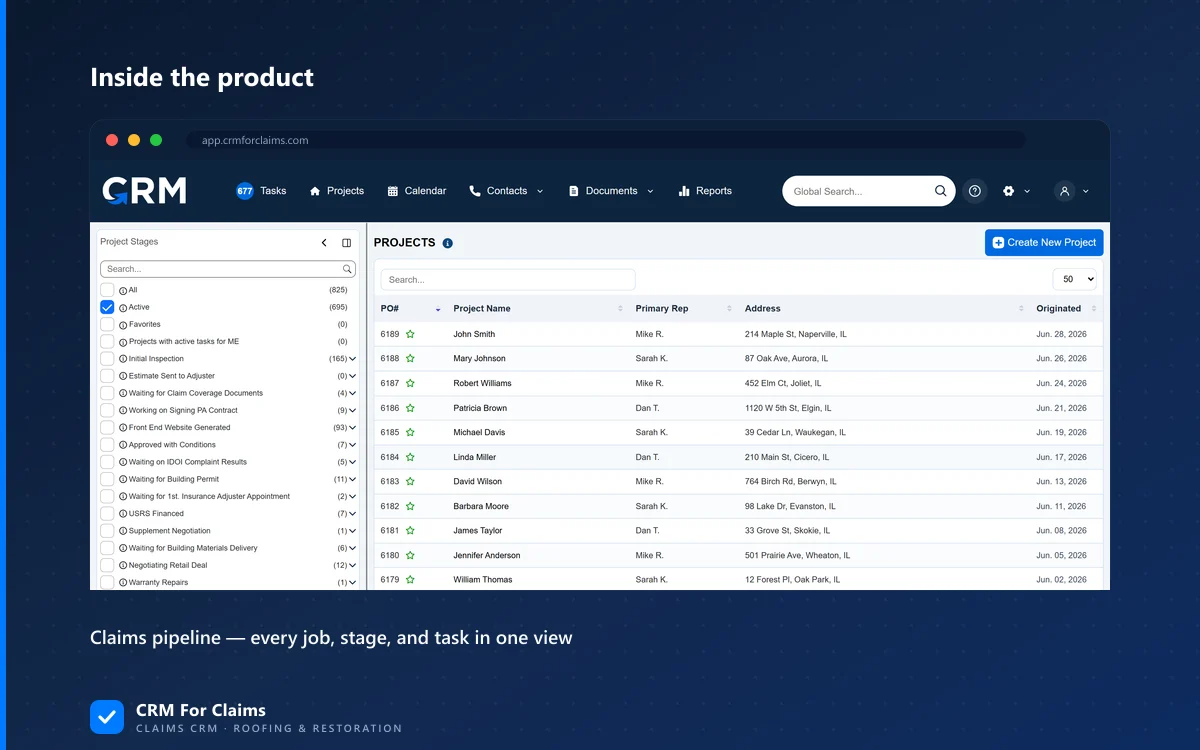
- Market as a structured field, not a prefix in the job name. Naming conventions survive about six weeks. The first person who types the city differently has removed those claims from every filter and every count, and nobody notices because the list still looks full.
- One pipeline with a market filter, not two pipelines. Separate stage lists per market mean you can never compare them, and every company-level report becomes a manual merge. The waiting-on-the-carrier queue matters most here — see it whole, then split it, rather than maintaining it twice.
- An owner and a next-action date on every claim. The substitute for walking past a whiteboard, and what makes a remote market auditable in five minutes instead of a phone call.
- Permissions that follow the market. A market lead needs their own claims, documents and customers. Whether they also need the margin is a separate decision — see who should see the money side of a claim — worth making deliberately before the second market rather than in a hurry afterwards.
Now the honest part. CRM For Claims does no route planning, mileage tracking or dispatch optimisation; if the drive is your central business problem, look at field service software built for that. It does no multi-entity accounting, maintains no per-state tax tables and tracks no licence renewals — your accounting system and your bookkeeper own those, and own them better than a CRM would. What we hold is the claim itself: stages, documents, messages and invoicing, plus who is responsible for what, across both markets. Weighing that against a general contractor CRM, the feature-by-feature comparison is the faster read.
When is a second market a mistake?
When market one still only runs because you are in it. The blunt test: can someone else take a live claim from intake to invoice using nothing but the record, without calling you? If not, a second market copies a process that exists mainly in your head, and the copy is always worse than the original.
The reason for expanding matters more than most people admit. A second market opened because market one is full is a capacity decision, and those usually survive contact with reality. One opened because market one has gone quiet is a hope, and it arrives with a fixed cost — registration, insurance, a person, a lot of driving — before it produces a dollar.
Chasing a storm into a market you intend to leave is a legitimate strategy and plenty of good companies do it. Just be clear-eyed that the exit is not clean: warranty obligations stay behind after the crews go home, and a callback where you no longer have a crew is an expensive drive to look at one shingle. Plan for it before the first job rather than the first complaint — handling callbacks after a claim closes works the same way whether or not you still work nearby.
None of this argues against a second market. It argues for opening one on purpose — defaults checked, owners named, one system holding both — instead of discovering the differences one refused permit at a time. To see what two markets look like in a claims-first system rather than in theory, book a live walkthrough and bring a real claim from the market that worries you most.